
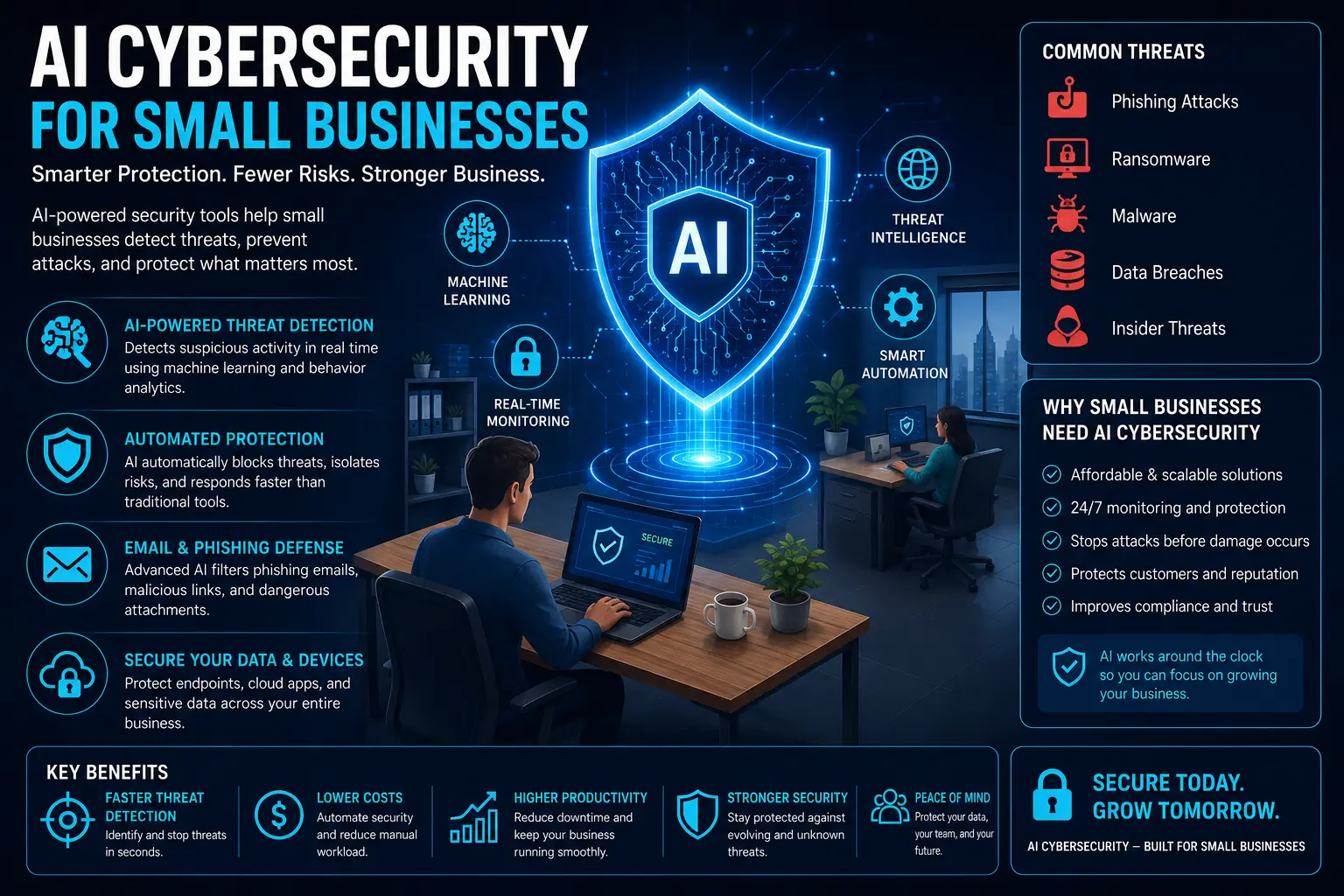
Learn how AI cybersecurity for small businesses improves threat detection, prevents cyberattacks, automates security, and protects critical data.
Introduction
Cybersecurity is no longer a concern exclusive to large enterprises. Today, small businesses face many of the same cyber threats as multinational corporations, including ransomware attacks, phishing scams, data breaches, account takeovers, and insider threats. Unfortunately, many small organizations lack dedicated security teams, large IT budgets, or advanced security infrastructure, making them attractive targets for cybercriminals.
This is where AI cybersecurity for small businesses is becoming a game changer. Artificial intelligence enables small companies to access enterprise-grade security capabilities without requiring massive investments in personnel or infrastructure. AI-powered security solutions can automatically detect threats, monitor networks, analyze suspicious behavior, prevent attacks, and respond to incidents faster than traditional security tools.
As cyber threats continue to evolve, small businesses increasingly rely on AI-driven cybersecurity platforms to improve protection while reducing operational complexity. This guide explores how AI cybersecurity works, why it matters for small businesses, its benefits, challenges, practical applications, and future trends shaping the cybersecurity landscape in 2026.
Why Small Businesses Are Increasingly Targeted by Cybercriminals
Many business owners mistakenly believe hackers primarily target large corporations. In reality, small businesses are frequent targets because they often have fewer security resources.
Common Reasons Small Businesses Are Targeted
Limited Security Budgets
Smaller organizations often lack dedicated cybersecurity investments.
Fewer Security Personnel
Many businesses rely on small IT teams or outsourced support.
Valuable Data
Small businesses store:
- Customer information
- Financial records
- Payment data
- Employee records
- Intellectual property
Supply Chain Access
Attackers may target smaller companies as a pathway into larger partner organizations.
The Financial Impact of Cyberattacks
Cyber incidents can lead to:
- Revenue loss
- Operational disruption
- Regulatory penalties
- Reputational damage
- Customer trust erosion
For many small businesses, even a single successful attack can have long-term consequences.
What Is AI Cybersecurity?
AI cybersecurity refers to the use of artificial intelligence technologies such as machine learning, behavioral analytics, deep learning, and automation to identify, prevent, and respond to cyber threats.
Unlike traditional security systems that rely primarily on predefined rules, AI systems continuously learn from data and adapt to evolving attack methods.
Core AI Technologies Used in Cybersecurity
Machine Learning
Machine learning helps identify unusual patterns and suspicious behavior.
Behavioral Analytics
AI establishes normal user and system behavior and detects deviations.
Predictive Analytics
AI forecasts potential threats before attacks occur.
Security Automation
AI can automate routine security tasks and incident response.
Threat Intelligence
AI analyzes vast amounts of threat data from multiple sources.
Why AI Cybersecurity Matters for Small Businesses
Small businesses face unique security challenges.
Limited Resources
Most small organizations cannot maintain large security teams.
Growing Threat Volume
Cyberattacks are becoming more frequent and sophisticated.
Need for Cost Efficiency
Businesses require solutions that maximize security while minimizing costs.
Increasing Compliance Requirements
Many industries require stronger data protection measures.
AI cybersecurity addresses these challenges by automating detection, analysis, and response.
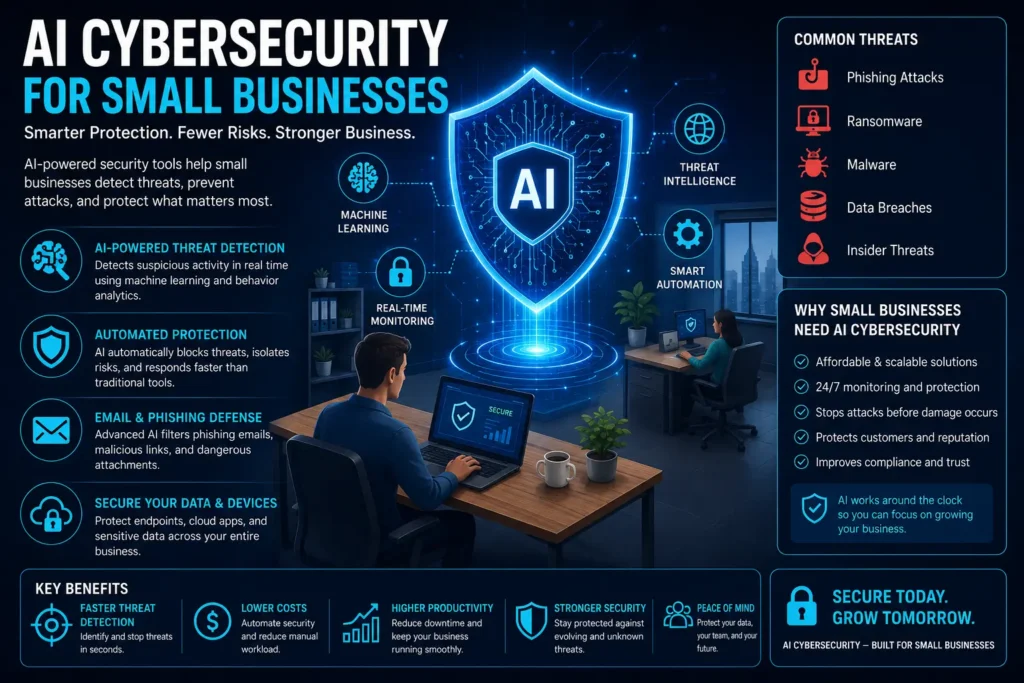
How AI Cybersecurity for Small Businesses Works
AI-powered security systems follow a continuous process.
Data Collection
Security tools gather information from:
- Endpoints
- Email systems
- Networks
- Cloud applications
- User activity
Pattern Analysis
Machine learning analyzes data to establish normal behavior.
Threat Detection
The system identifies suspicious activity and potential attacks.
Automated Response
AI can:
- Block malicious traffic
- Quarantine devices
- Disable compromised accounts
- Alert administrators
Continuous Learning
The system becomes more accurate over time.
Key Applications of AI Cybersecurity for Small Businesses
AI-Powered Email Security
Email remains one of the most common attack vectors.
Threats Addressed
- Phishing attacks
- Business email compromise
- Malware attachments
- Social engineering
AI Benefits
AI analyzes:
- Sender behavior
- Message content
- URL reputation
- Attachment activity
This improves phishing detection significantly.
Endpoint Protection
Every device connected to a business network represents a potential entry point.
Protected Devices
- Laptops
- Desktops
- Smartphones
- Tablets
- Servers
AI Capabilities
- Malware detection
- Behavioral monitoring
- Threat isolation
- Ransomware prevention
Network Security Monitoring
AI continuously analyzes network traffic.
Functions
- Intrusion detection
- Traffic analysis
- Anomaly detection
- Threat prioritization
Example
If unusual data transfers occur outside normal business hours, AI can trigger alerts and initiate investigations.
Cloud Security
Many small businesses rely on cloud services.
Common Platforms
- Microsoft 365
- Google Workspace
- AWS
- Azure
AI Security Features
- Misconfiguration detection
- Unauthorized access monitoring
- Risk analysis
- Data protection
Identity and Access Management (IAM)
Identity security is becoming increasingly important.
AI Enhancements
- Adaptive authentication
- Risk-based access control
- Behavioral biometrics
- Continuous verification
This helps prevent account compromise.
Best AI Cybersecurity Solutions for Small Businesses
Microsoft Defender for Business
Designed specifically for small and medium-sized organizations.
Features
- Endpoint protection
- Threat detection
- Automated response
- Microsoft ecosystem integration
CrowdStrike Falcon Go
Cloud-native endpoint security platform.
Benefits
- Lightweight deployment
- AI-powered threat detection
- Ransomware protection
SentinelOne Singularity
Provides autonomous endpoint protection.
Strengths
- Behavioral AI
- Automated remediation
- Real-time monitoring
Cisco Secure Endpoint
Combines AI with advanced endpoint security.
Key Features
- Malware protection
- Threat intelligence
- Device visibility
Malwarebytes ThreatDown
Popular among small businesses.
Advantages
- Affordable pricing
- Easy deployment
- Strong ransomware defense
Comparison Table of AI Cybersecurity Solutions for Small Businesses
| Solution | Primary Focus | AI Features | Best For |
|---|---|---|---|
| Microsoft Defender for Business | Endpoint Security | Threat Detection | Microsoft Users |
| CrowdStrike Falcon Go | Endpoint Protection | Behavioral AI | Growing Businesses |
| SentinelOne | Autonomous Security | Automated Response | Advanced Protection |
| Cisco Secure Endpoint | Threat Prevention | AI Analytics | Network Security |
| Malwarebytes ThreatDown | Malware Protection | Threat Detection | Budget-Conscious Businesses |
Real-World Use Cases
Retail Businesses
AI helps protect:
- Payment systems
- Customer data
- E-commerce platforms
Benefits
- Fraud detection
- Data protection
- Reduced downtime
Healthcare Clinics
Healthcare providers secure:
- Patient records
- Medical devices
- Administrative systems
AI Advantages
- Compliance support
- Threat detection
- Access monitoring
Professional Services Firms
Law firms and consulting businesses use AI cybersecurity to protect confidential client information.
Manufacturing Companies
AI helps secure operational systems and connected devices.
Benefits of AI Cybersecurity for Small Businesses
Improved Threat Detection
AI identifies threats faster than traditional methods.
Reduced Security Costs
Automation lowers the need for large security teams.
24/7 Monitoring
Continuous protection without requiring around-the-clock staffing.
Faster Incident Response
Threats can be contained quickly.
Better Protection Against Ransomware
AI recognizes suspicious behavior before encryption spreads.
Enhanced Compliance
AI tools help support regulatory requirements.
Scalability
Security capabilities grow alongside the business.
AI Cybersecurity Trends Impacting Small Businesses
Managed AI Security Services
Small businesses increasingly rely on managed providers offering AI-powered protection.
Extended Detection and Response (XDR)
XDR platforms combine:
- Endpoint security
- Network monitoring
- Identity protection
- Cloud security
into a single solution.
Generative AI Security Assistants
AI assistants help business owners understand threats and security recommendations.
Cloud-Native Security
Cloud-first AI security solutions continue gaining popularity.
Challenges and Limitations
Despite its benefits, AI cybersecurity is not without challenges.
Initial Costs
Advanced security platforms may require upfront investment.
Learning Curve
Businesses may need training to maximize effectiveness.
False Positives
AI systems can occasionally generate inaccurate alerts.
Data Privacy Concerns
Security tools often process sensitive information.
Integration Challenges
Some businesses may face difficulties integrating new tools with existing systems.
Overreliance on Automation
Human oversight remains important for complex incidents.
Future Trends in AI Cybersecurity for Small Businesses
Autonomous Security Operations
Future platforms will increasingly automate:
- Detection
- Investigation
- Remediation
with minimal human involvement.
Predictive Security Analytics
AI will forecast threats before attacks occur.
AI-Powered Cyber Insurance Support
Security tools may help businesses qualify for better cyber insurance coverage.
Enhanced Zero Trust Security
AI will strengthen continuous verification and access control.
Improved Threat Intelligence Sharing
Businesses will benefit from collective AI-driven threat intelligence networks.
Explainable AI
Future systems will provide clearer explanations for security decisions and alerts.
FAQ
1. What is AI cybersecurity for small businesses?
AI cybersecurity uses artificial intelligence to help small businesses detect threats, monitor systems, prevent attacks, and automate security operations.
2. Can small businesses afford AI cybersecurity solutions?
Yes. Many vendors offer affordable solutions specifically designed for small and medium-sized businesses.
3. How does AI improve cybersecurity?
AI improves cybersecurity through faster threat detection, behavioral analysis, automation, predictive intelligence, and continuous monitoring.
4. Can AI stop ransomware attacks?
Many AI-powered platforms can identify ransomware behavior early and isolate affected devices before significant damage occurs.
5. What is the best AI cybersecurity solution for small businesses?
Popular options include Microsoft Defender for Business, CrowdStrike Falcon Go, SentinelOne, Cisco Secure Endpoint, and Malwarebytes ThreatDown.
6. Does AI replace cybersecurity professionals?
No. AI assists with detection and automation, but human expertise remains essential for decision-making and incident management.
7. Why are cybercriminals targeting small businesses?
Small businesses often have valuable data but fewer security resources, making them attractive targets for attackers.
Conclusion
AI cybersecurity for small businesses is transforming how organizations defend against modern cyber threats. By combining machine learning, behavioral analytics, automation, and threat intelligence, AI enables smaller companies to access advanced security capabilities that were once available only to large enterprises.
From email protection and endpoint security to cloud monitoring and identity management, AI-powered cybersecurity tools help businesses improve protection while reducing operational complexity and costs. Although challenges such as implementation, privacy concerns, and false positives remain, the benefits of AI-driven security far outweigh the limitations for most organizations.
As cyber threats continue to evolve, small businesses that invest in AI cybersecurity solutions will be better positioned to protect customer data, maintain business continuity, and build long-term resilience.
Key Takeaways
- AI cybersecurity for small businesses provides enterprise-grade protection through automation and machine learning.
- Small businesses are increasingly targeted by ransomware, phishing, and data breach attacks.
- AI improves threat detection, response speed, and overall security visibility.
- Email security, endpoint protection, and network monitoring are major AI cybersecurity applications.
- Microsoft Defender for Business, CrowdStrike Falcon Go, and SentinelOne are leading solutions.
- AI helps reduce costs by automating routine security tasks.
- Continuous monitoring improves protection against emerging threats.
- Human oversight remains important despite growing automation.
- Future AI cybersecurity platforms will become more autonomous and predictive.
- Investing in AI-driven security helps small businesses strengthen resilience and reduce cyber risk.
