
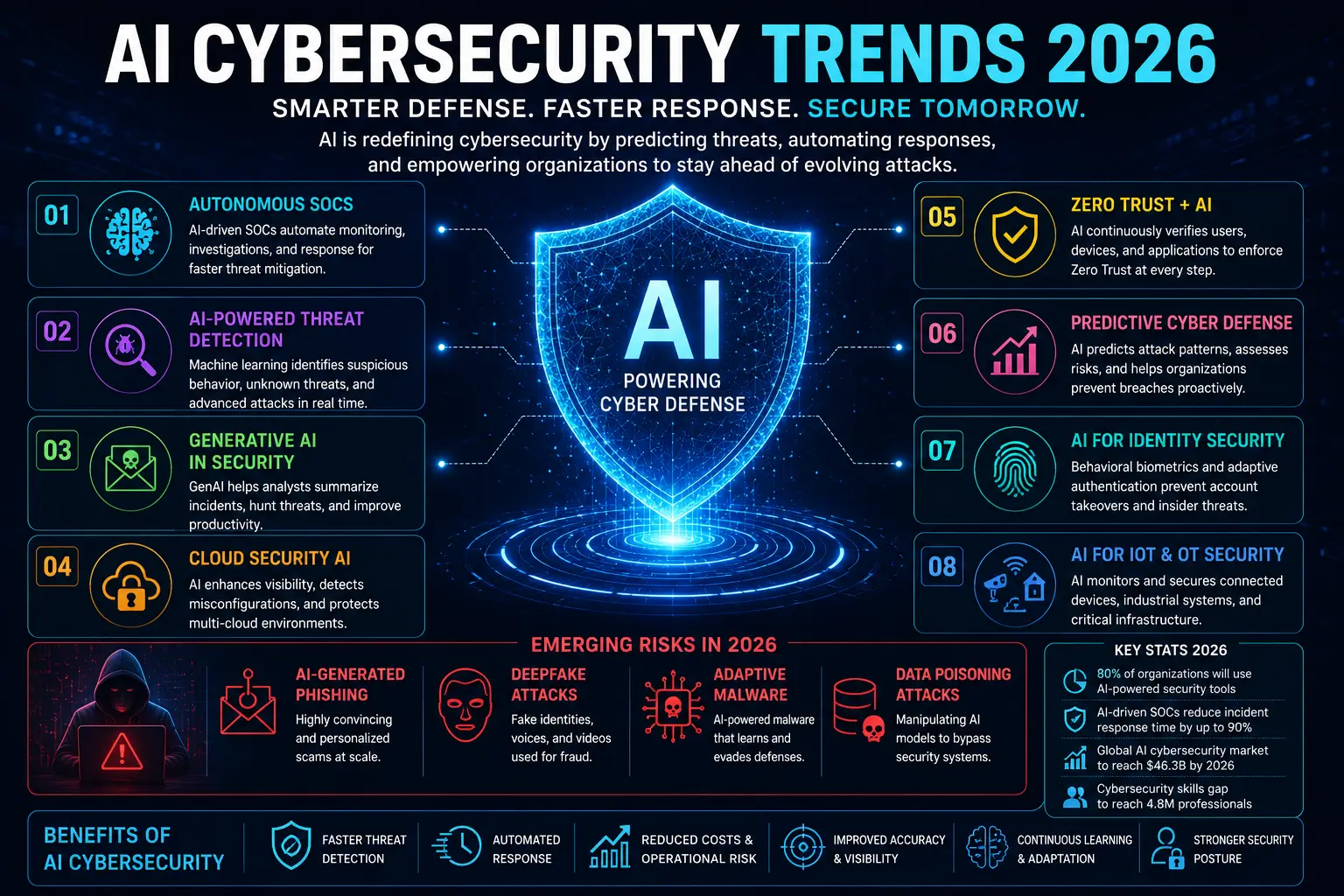
Explore the top AI cybersecurity trends 2026, including autonomous security, AI threat detection, Zero Trust, cloud security, and cyber defense innovations.
Introduction
Cybersecurity is entering a new era driven by artificial intelligence. As organizations face increasingly sophisticated cyberattacks, traditional security methods are no longer sufficient on their own. Cybercriminals are leveraging automation, machine learning, and generative AI to launch faster and more targeted attacks, forcing defenders to adopt equally advanced technologies.
The most important AI cybersecurity trends 2026 reflect this ongoing technological arms race. Artificial intelligence is no longer just a supporting tool in cybersecurity—it is becoming the foundation of modern threat detection, incident response, vulnerability management, fraud prevention, and cyber resilience strategies.
From autonomous Security Operations Centers (SOCs) and AI-powered threat hunting to predictive risk analytics and quantum-ready security, organizations are rapidly transforming how they defend digital assets. Businesses, governments, developers, and cybersecurity professionals must understand these trends to stay ahead of evolving threats.
This comprehensive guide explores the most significant AI cybersecurity developments shaping 2026, their practical applications, industry impact, benefits, challenges, and future outlook.
Why AI Is Reshaping Cybersecurity
Cybersecurity teams face several growing challenges:
- Increasing attack complexity
- Expanding cloud environments
- Remote and hybrid workforces
- Rising ransomware incidents
- Shortage of cybersecurity professionals
- Massive volumes of security data
AI helps address these challenges by automating analysis, accelerating response times, and improving threat visibility.
The Shift Toward Intelligent Cyber Defense
Traditional cybersecurity relies heavily on:
- Static rules
- Signature-based detection
- Manual investigations
Modern AI cybersecurity systems focus on:
- Behavioral analysis
- Predictive intelligence
- Automated response
- Continuous learning
This shift is redefining how organizations protect critical infrastructure and sensitive information.
Top AI Cybersecurity Trends 2026
Autonomous Security Operations Centers (SOCs)
One of the biggest AI cybersecurity trends 2026 is the rise of autonomous SOCs.
Security Operations Centers traditionally require large teams to monitor alerts and investigate incidents.
How AI Is Changing SOCs
AI now helps:
- Prioritize alerts
- Investigate threats
- Correlate security events
- Generate incident reports
- Recommend remediation actions
Benefits
- Faster investigations
- Reduced analyst workload
- Lower operational costs
- Improved threat detection
Organizations increasingly view AI as a force multiplier rather than a replacement for security professionals.
AI-Powered Threat Detection and Response
Threat detection remains one of the most mature applications of AI in cybersecurity.
Key Capabilities
AI can identify:
- Unknown malware
- Insider threats
- Account compromise
- Suspicious network activity
- Advanced persistent threats (APTs)
Real-World Example
An employee account suddenly accesses sensitive files from multiple countries within hours.
AI can:
- Detect abnormal behavior.
- Flag potential compromise.
- Trigger automated containment.
- Notify security teams.
This process can occur within seconds.
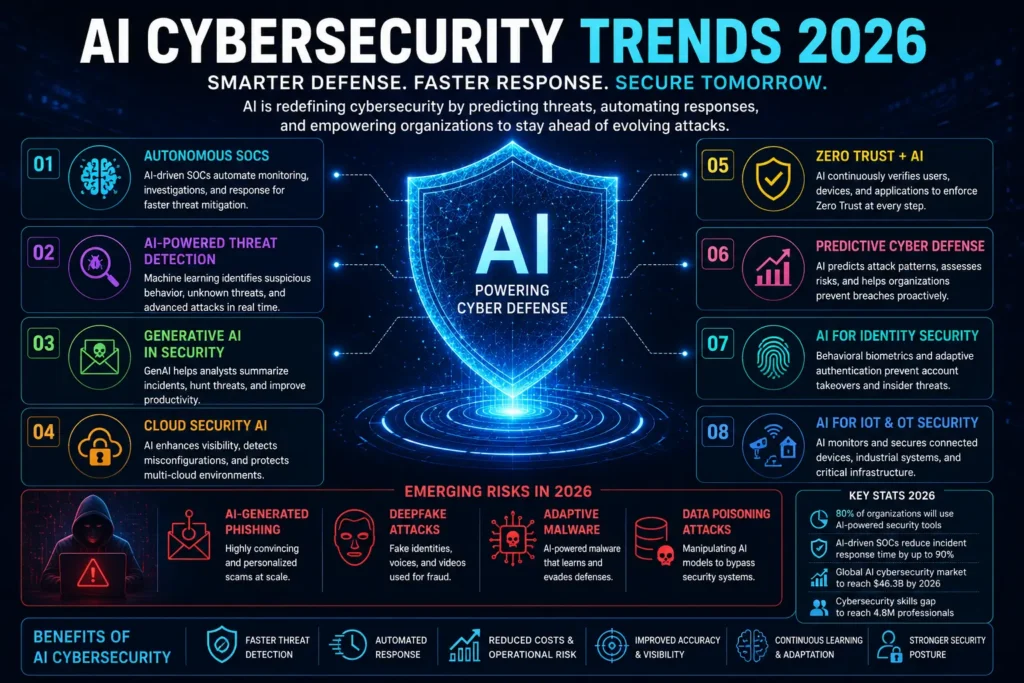
Generative AI in Security Operations
Generative AI is rapidly becoming a core component of modern cybersecurity platforms.
Security Applications
Generative AI can:
- Summarize incidents
- Generate threat reports
- Assist investigations
- Explain alerts
- Support threat hunting
Benefits for Analysts
Instead of manually reviewing thousands of events, analysts receive concise AI-generated summaries.
This significantly improves productivity.
AI-Driven Threat Intelligence
Threat intelligence is becoming increasingly AI-powered.
Sources Analyzed
AI systems continuously process:
- Security feeds
- Vulnerability databases
- Dark web activity
- Open-source intelligence
- Industry reports
Outcomes
Organizations gain:
- Faster awareness of threats
- Better risk prioritization
- Improved attack forecasting
This trend is helping security teams move from reactive defense to proactive protection.
The Rise of AI-Powered Cyberattacks
While AI strengthens defenses, attackers are also leveraging AI technologies.
AI-Generated Phishing
Generative AI allows attackers to create:
- Personalized phishing emails
- Business email compromise messages
- Multilingual scams
- Convincing social engineering content
Why It’s Dangerous
AI-generated phishing campaigns often appear highly authentic and difficult to detect.
Deepfake-Based Attacks
Deepfake technology is becoming a growing cybersecurity concern.
Attack Scenarios
Cybercriminals may create:
- Fake executive videos
- Synthetic voice calls
- Fraudulent identity verification attempts
Industry Impact
Financial institutions and enterprises are investing heavily in AI-powered deepfake detection tools.
Adaptive Malware
Future malware increasingly uses AI techniques.
Capabilities
Adaptive malware can:
- Modify behavior dynamically
- Avoid detection systems
- Learn from defensive actions
This creates a more challenging threat landscape for defenders.
AI and Zero Trust Security
Zero Trust continues to be a major cybersecurity strategy.
What Is Zero Trust?
The Zero Trust model assumes:
Never trust, always verify.
Every user, device, and application must continuously prove legitimacy.
How AI Enhances Zero Trust
AI supports:
- Continuous authentication
- Behavioral analytics
- Risk scoring
- Identity verification
Example
If a user logs in from an unusual location, AI can automatically increase authentication requirements.
This improves security without significantly impacting user experience.
Cloud Security Becomes More Intelligent
Cloud adoption continues accelerating in 2026.
Key Security Challenges
Organizations must protect:
- Multi-cloud environments
- SaaS applications
- Cloud workloads
- APIs
- Containers
AI’s Role
AI-powered cloud security tools help:
- Detect misconfigurations
- Monitor user activity
- Identify anomalies
- Prevent data leakage
Cloud-native AI security platforms are becoming standard across enterprises.
AI-Powered Vulnerability Management
Traditional vulnerability management often struggles with prioritization.
Organizations may have thousands of vulnerabilities but limited resources.
AI-Based Prioritization
AI evaluates:
- Exploit likelihood
- Business impact
- Threat intelligence
- Asset criticality
Benefits
Security teams can focus on vulnerabilities that pose the greatest risk.
This improves remediation efficiency.
AI in Identity and Access Management (IAM)
Identity remains one of the most targeted attack vectors.
Emerging AI Capabilities
AI-powered IAM solutions offer:
- Behavioral biometrics
- Adaptive authentication
- Continuous verification
- Risk-based access control
Practical Example
Instead of relying solely on passwords, AI analyzes:
- Typing behavior
- Mouse movement
- Device characteristics
- Usage patterns
This creates stronger identity protection.
AI-Powered Security for IoT and Smart Devices
The growth of connected devices creates new attack surfaces.
Devices Requiring Protection
- Smart home systems
- Medical devices
- Industrial sensors
- Security cameras
- Wearables
AI Security Applications
AI helps:
- Monitor device behavior
- Detect anomalies
- Prevent unauthorized access
- Identify compromised devices
This trend is particularly important as IoT ecosystems continue expanding.
Comparison Table: Key AI Cybersecurity Trends 2026
| Trend | Primary Purpose | Business Impact |
|---|---|---|
| Autonomous SOCs | Security Automation | Faster Response |
| Generative AI Security | Investigation Support | Analyst Productivity |
| AI Threat Detection | Threat Identification | Improved Protection |
| Zero Trust AI | Access Security | Reduced Risk |
| Cloud AI Security | Cloud Protection | Better Visibility |
| AI Vulnerability Management | Risk Prioritization | Efficient Remediation |
| AI IAM | Identity Security | Stronger Authentication |
| IoT Security AI | Device Protection | Expanded Coverage |
Industry Insights and Market Developments
Several major developments are shaping cybersecurity investments.
Security Spending Continues Rising
Organizations are increasing budgets for:
- AI-powered security tools
- Threat intelligence platforms
- Cloud security solutions
- Security automation
Regulatory Pressure
Governments worldwide are introducing stricter cybersecurity requirements.
Organizations must increasingly demonstrate:
- Risk management
- Data protection
- AI governance
Cybersecurity Talent Gap
The shortage of skilled professionals remains significant.
AI helps bridge this gap by automating repetitive security tasks.
Benefits of AI Cybersecurity Trends 2026
Faster Threat Detection
AI identifies threats in real time.
Improved Accuracy
Machine learning reduces false positives and false negatives.
Enhanced Scalability
AI processes vast amounts of data efficiently.
Better Incident Response
Automated workflows improve containment speed.
Increased Security Visibility
Organizations gain deeper insight into their environments.
Reduced Operational Costs
Automation lowers manual workload.
Proactive Defense
AI helps predict and prevent attacks before they occur.
Challenges and Limitations
Despite its advantages, AI cybersecurity faces challenges.
Adversarial AI Attacks
Attackers may target AI models directly.
Examples include:
- Data poisoning
- Model manipulation
- Evasion attacks
Privacy Concerns
AI systems often process sensitive user data.
Organizations must comply with privacy regulations.
Implementation Complexity
Deploying AI security solutions can require:
- Skilled personnel
- Integration planning
- Continuous tuning
Dependence on Data Quality
Poor data quality can negatively impact AI performance.
Cost Considerations
Advanced AI security platforms may require significant investment.
Future Trends Beyond 2026
Fully Autonomous Security Platforms
Future systems may independently:
- Detect threats
- Investigate incidents
- Execute responses
with minimal human involvement.
Predictive Cybersecurity
AI will increasingly forecast attacks before they happen.
Quantum-Ready Security
AI will support migration toward quantum-resistant cryptography.
Explainable AI Security
Security teams will demand more transparency regarding AI decisions.
Human-AI Security Collaboration
The future of cybersecurity will focus on combining:
- Human expertise
- Machine intelligence
- Automated workflows
for stronger overall defense.
FAQ
1. What are the most important AI cybersecurity trends 2026?
Major trends include autonomous SOCs, AI-powered threat detection, generative AI security tools, Zero Trust integration, cloud security automation, and predictive cyber defense.
2. How is generative AI affecting cybersecurity?
Generative AI helps defenders automate investigations and reporting while also enabling attackers to create more sophisticated phishing and social engineering attacks.
3. Will AI replace cybersecurity professionals?
No. AI enhances security teams by automating repetitive tasks and improving analysis, but human expertise remains essential.
4. What role does AI play in Zero Trust security?
AI supports continuous authentication, behavioral analytics, adaptive access control, and risk assessment within Zero Trust frameworks.
5. How does AI improve cloud security?
AI detects cloud misconfigurations, monitors user activity, identifies threats, and protects cloud workloads in real time.
6. What are the risks of AI cybersecurity?
Potential risks include adversarial attacks, privacy concerns, implementation complexity, data quality issues, and overreliance on automation.
7. Why are organizations investing heavily in AI cybersecurity?
AI helps organizations improve threat detection, automate responses, reduce costs, enhance visibility, and address cybersecurity talent shortages.
Conclusion
The most significant AI cybersecurity trends 2026 demonstrate that artificial intelligence has become a central pillar of modern cyber defense. Organizations are increasingly leveraging AI for threat detection, incident response, cloud security, identity protection, vulnerability management, and security automation.
At the same time, cybercriminals are adopting AI to launch more sophisticated attacks, creating an ongoing technological arms race between attackers and defenders. Success in this environment requires organizations to embrace intelligent security platforms while maintaining strong governance, human oversight, and cybersecurity best practices.
Businesses that invest in AI-driven cybersecurity today will be better positioned to protect critical assets, improve operational resilience, and stay ahead of emerging threats throughout 2026 and beyond.
Key Takeaways
- AI cybersecurity trends 2026 are reshaping modern cyber defense strategies.
- Autonomous SOCs are reducing analyst workload and improving response times.
- AI-powered threat detection identifies threats faster than traditional systems.
- Generative AI is transforming investigations, reporting, and threat hunting.
- Attackers are increasingly using AI for phishing, deepfakes, and adaptive malware.
- Zero Trust security benefits significantly from AI-driven risk analysis.
- Cloud security platforms are becoming more intelligent and automated.
- AI improves vulnerability management through risk-based prioritization.
- IoT and connected device security increasingly rely on AI-powered monitoring.
- Human expertise remains essential despite growing cybersecurity automation.
