
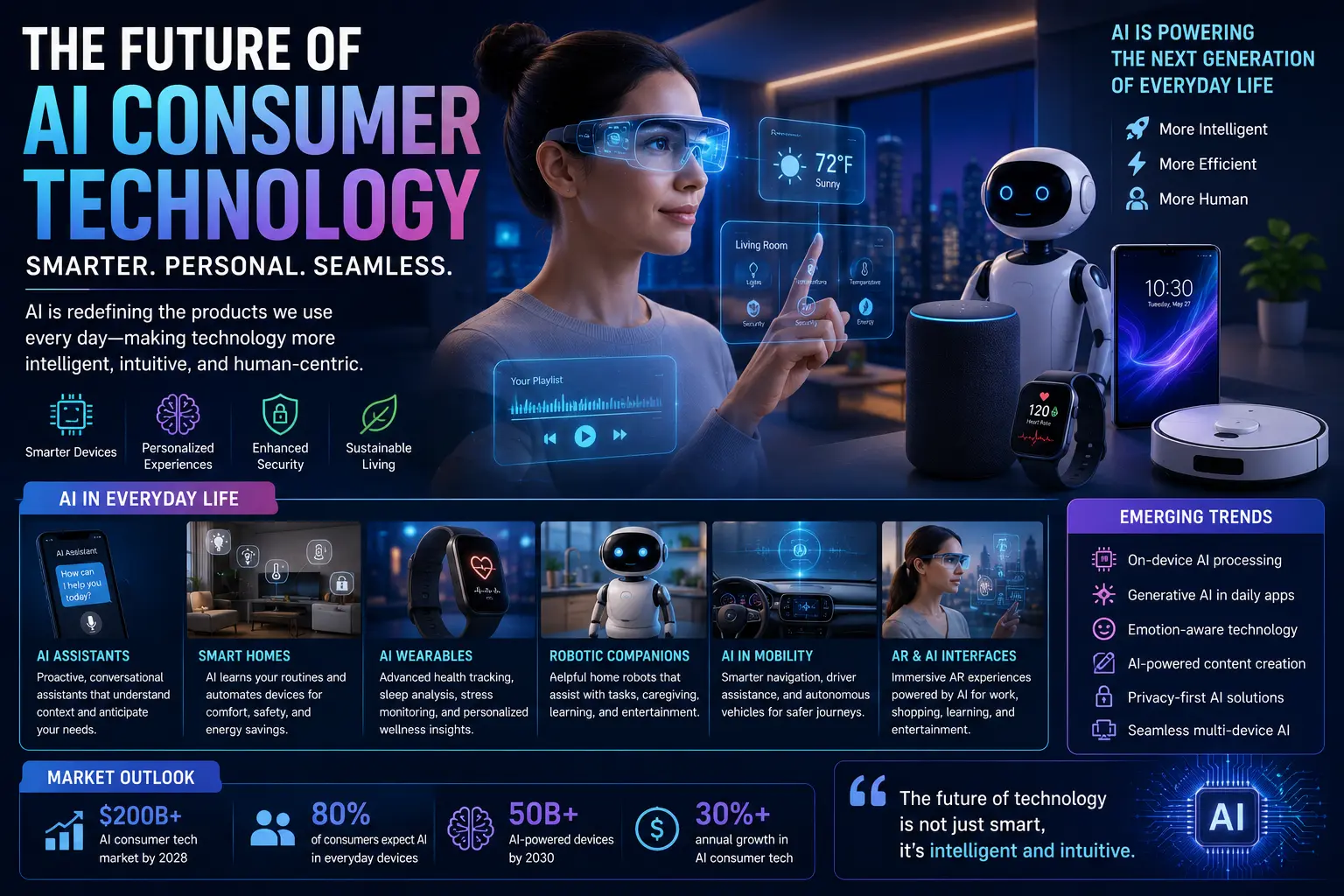
Explore future AI consumer technology trends, smart devices, AI assistants, wearables, robotics, and innovations transforming everyday life.
Introduction
Artificial intelligence is rapidly moving beyond enterprise software and research laboratories into homes, smartphones, vehicles, wearable devices, and everyday consumer products. The rise of intelligent assistants, smart home automation, AI-powered wearables, and personalized digital experiences is fundamentally changing how people interact with technology.
The future AI consumer technology landscape promises even more dramatic transformations. Future consumer devices will not only respond to commands but also anticipate needs, make decisions, automate tasks, and deliver highly personalized experiences. From AI-powered health monitoring and autonomous household robots to augmented reality glasses and context-aware digital assistants, consumers are entering an era where technology becomes increasingly intelligent, proactive, and integrated into daily life.
Major technology companies including Apple, Google, Microsoft, Amazon, Meta, Samsung, and emerging AI startups are investing billions of dollars in developing next-generation AI products. As hardware capabilities improve and AI models become more sophisticated, consumer technology will become smarter, faster, and more useful than ever before.
This comprehensive guide explores the future of AI consumer technology, emerging innovations, industry trends, benefits, challenges, and how artificial intelligence is expected to shape everyday experiences throughout the coming decade.
Understanding AI Consumer Technology
AI consumer technology refers to products and services that use artificial intelligence to improve user experiences, automate tasks, and provide intelligent functionality.
Common Examples Today
Current AI-powered consumer technologies include:
- Smart speakers
- Voice assistants
- Smart home devices
- AI smartphones
- Fitness wearables
- Recommendation engines
- Smart security cameras
These technologies represent only the beginning of AI’s impact on consumers.
Why AI Consumer Technology Is Growing
Several factors are accelerating adoption:
- More powerful AI models
- Faster processors
- Improved cloud computing
- Affordable smart devices
- Increased consumer demand
- Better personalization capabilities
Consumers increasingly expect technology to be intelligent and adaptive.
Key Drivers Shaping the Future AI Consumer Technology Market
Advances in Generative AI
Generative AI is transforming consumer experiences.
Applications Include
- Personalized assistants
- Content creation
- Real-time translation
- Intelligent search
Future consumer devices will increasingly incorporate generative AI capabilities.
Edge AI Processing
Edge AI enables devices to process data locally.
Benefits
- Faster responses
- Better privacy
- Reduced internet dependency
This technology is becoming essential for future smart devices.
Growing Demand for Personalization
Consumers want products tailored to their preferences.
AI enables:
- Personalized recommendations
- Adaptive interfaces
- Customized experiences
This trend continues driving innovation.
Expanding Smart Device Ecosystems
Connected ecosystems are becoming increasingly important.
Consumers expect seamless integration between:
- Smartphones
- Smart homes
- Wearables
- Vehicles
- Entertainment systems
AI-Powered Smart Homes of the Future
Smart homes are expected to become significantly more intelligent.
Predictive Home Automation
Future systems will anticipate needs rather than simply respond to commands.
Examples
- Adjusting temperature automatically
- Managing energy consumption
- Scheduling household tasks
AI will learn from user behavior and optimize home environments.
Intelligent Home Security
Future AI security systems will provide:
- Behavioral analysis
- Threat prediction
- Facial recognition
- Automated responses
Benefits
Improved safety with fewer false alarms.
Smart Energy Management
AI will optimize energy usage across homes.
Capabilities
- Monitoring consumption
- Predicting usage patterns
- Reducing utility costs
Sustainability will become a key focus area.

The Evolution of AI Personal Assistants
AI assistants are expected to become dramatically more capable.
From Reactive to Proactive
Today’s assistants respond to requests.
Future assistants will:
- Anticipate needs
- Schedule tasks
- Conduct research
- Manage workflows
Real-World Example
A future AI assistant may automatically:
- Reschedule meetings
- Order groceries
- Plan travel
- Manage finances
with minimal user input.
Multimodal Interaction
Future assistants will understand:
- Voice
- Text
- Images
- Video
- Context
This will enable more natural interactions.
Personalized Intelligence
AI assistants will develop deeper understanding of:
- Preferences
- Habits
- Goals
- Communication styles
resulting in highly customized experiences.
AI Wearables and Personal Health Technology
Health-focused AI devices are expected to become more sophisticated.
Continuous Health Monitoring
Future wearables may monitor:
- Heart health
- Blood pressure
- Glucose levels
- Sleep quality
- Stress indicators
Benefits
Earlier detection of health issues and improved wellness management.
AI-Powered Preventive Healthcare
Future devices may provide:
- Personalized health recommendations
- Early warning systems
- Risk assessments
before symptoms become serious.
Mental Health Applications
AI may assist with:
- Stress monitoring
- Mood analysis
- Wellness coaching
through wearable devices and mobile applications.
AI Smartphones and Mobile Technology
Smartphones remain central to consumer technology.
On-Device AI Processing
Future phones will perform more AI tasks locally.
Advantages
- Improved privacy
- Faster performance
- Reduced cloud dependency
Intelligent User Interfaces
AI-powered interfaces will adapt based on:
- Usage patterns
- Context
- User preferences
Advanced Photography
AI will continue improving:
- Image enhancement
- Object recognition
- Real-time editing
- Video generation
AI Robotics for Consumers
Consumer robotics represents one of the most exciting growth areas.
Household Robots
Future robots may assist with:
- Cleaning
- Cooking
- Laundry
- Home maintenance
Impact
Robotics could significantly reduce household workloads.
Personal Companion Robots
AI companions may provide:
- Assistance
- Education
- Entertainment
- Social interaction
particularly for elderly individuals.
Educational Robots
Future educational robots could offer personalized learning experiences for students.
AI and Immersive Technologies
Augmented Reality (AR)
AI will enhance AR experiences.
Applications
- Navigation
- Shopping
- Education
- Workplace productivity
Smart Glasses
Future smart glasses may provide:
- Real-time translation
- Contextual information
- Navigation assistance
without requiring smartphone interaction.
Mixed Reality Experiences
AI will help create seamless interactions between digital and physical environments.
Comparison Table: Current vs Future AI Consumer Technology
| Technology Category | Current Capabilities | Future Capabilities |
|---|---|---|
| AI Assistants | Voice Commands | Autonomous Task Management |
| Smart Homes | Automation Rules | Predictive Intelligence |
| Wearables | Fitness Tracking | Advanced Health Monitoring |
| Smartphones | AI Features | Personalized AI Systems |
| Security Cameras | Motion Detection | Behavioral Analysis |
| Robots | Single Tasks | Multi-Purpose Assistance |
| AR Devices | Visual Overlays | Context-Aware Experiences |
| Vehicles | Driver Assistance | Greater Autonomy |
Benefits of Future AI Consumer Technology
Greater Convenience
AI automates everyday tasks and simplifies routines.
Improved Productivity
Consumers can save time through intelligent automation.
Enhanced Personalization
Technology adapts to individual preferences and needs.
Better Health Management
Wearables and AI health tools provide valuable insights.
Increased Accessibility
AI helps individuals with disabilities interact more effectively with technology.
Improved Safety
AI enhances home security, vehicle safety, and digital protection.
Energy Efficiency
Smart systems optimize resource usage and reduce waste.
Challenges and Limitations
Privacy Concerns
Future AI devices will collect large amounts of personal data.
Organizations must prioritize:
- Data protection
- Transparency
- User control
Cybersecurity Risks
Connected devices increase potential attack surfaces.
Threats Include
- Device hacking
- Data theft
- Identity compromise
Ethical Considerations
Questions surrounding:
- AI bias
- Surveillance
- Decision-making
remain important.
Cost Barriers
Advanced AI technologies may initially be expensive for many consumers.
Technology Dependence
Overreliance on AI may create new societal challenges.
Industry Trends and Expert Insights
AI Is Becoming Invisible
Future technology will increasingly operate in the background rather than requiring direct interaction.
Consumer Expectations Are Changing
Users increasingly expect:
- Instant responses
- Personalization
- Automation
from every device.
Ecosystems Will Matter More Than Individual Devices
Success will depend on seamless integration across multiple products and platforms.
AI Hardware Innovation Is Accelerating
Advances in processors and AI chips continue enabling more powerful consumer experiences.
Future Trends
Autonomous Digital Assistants
Future assistants will independently manage complex tasks.
AI-Powered Smart Cities
Consumer devices will increasingly interact with intelligent urban infrastructure.
Emotion-Aware AI
Future systems may recognize and respond to emotional states.
Personalized AI Companions
Consumers may have dedicated AI companions tailored to their needs and preferences.
AI-Enhanced Transportation
Vehicles will become increasingly autonomous and intelligent.
Human-AI Collaboration
Consumers will work alongside AI rather than simply using it as a tool.
FAQ
1. What is future AI consumer technology?
Future AI consumer technology refers to intelligent products and services that use advanced artificial intelligence to improve daily life through automation, personalization, and smart decision-making.
2. Which consumer devices will benefit most from AI?
Smartphones, wearables, smart home systems, AI assistants, robotics, smart glasses, and connected vehicles are expected to benefit significantly.
3. Will AI replace smartphones?
AI is more likely to enhance smartphones rather than replace them entirely, although new interfaces such as smart glasses may reduce dependence on traditional devices.
4. How will AI improve healthcare for consumers?
AI-powered wearables and health platforms may provide continuous monitoring, early disease detection, and personalized wellness recommendations.
5. Are AI-powered smart homes secure?
Modern smart homes can be secure, but users should prioritize strong passwords, software updates, encryption, and trusted device manufacturers.
6. What role will robotics play in future consumer technology?
Consumer robots may assist with household tasks, caregiving, education, and personal assistance.
7. What are the biggest challenges facing AI consumer technology?
Privacy concerns, cybersecurity risks, ethical issues, affordability, and regulatory compliance remain major challenges.
Conclusion
The future AI consumer technology landscape is poised to redefine how people interact with the digital world. Intelligent assistants, predictive smart homes, advanced wearables, autonomous robots, AI-enhanced smartphones, and immersive technologies will increasingly become part of everyday life.
As artificial intelligence continues to evolve, consumer technology will become more proactive, personalized, and integrated across devices and environments. While challenges related to privacy, security, ethics, and accessibility remain important considerations, the opportunities created by AI-driven innovation are enormous.
Consumers, businesses, and technology providers that embrace these advancements responsibly will be best positioned to benefit from the next generation of intelligent products and services.
Key Takeaways
- Future AI consumer technology will focus on personalization, automation, and intelligent decision-making.
- AI assistants will evolve into proactive digital companions.
- Smart homes will become predictive and context-aware.
- Wearables will support advanced health monitoring and preventive care.
- Consumer robotics will expand beyond simple automation tasks.
- AI smartphones will feature powerful on-device intelligence.
- AR and smart glasses will transform digital interactions.
- Privacy and cybersecurity will remain major priorities.
- Ecosystem integration will become increasingly important.
- AI will fundamentally reshape how consumers live, work, communicate, and interact with technology.
