
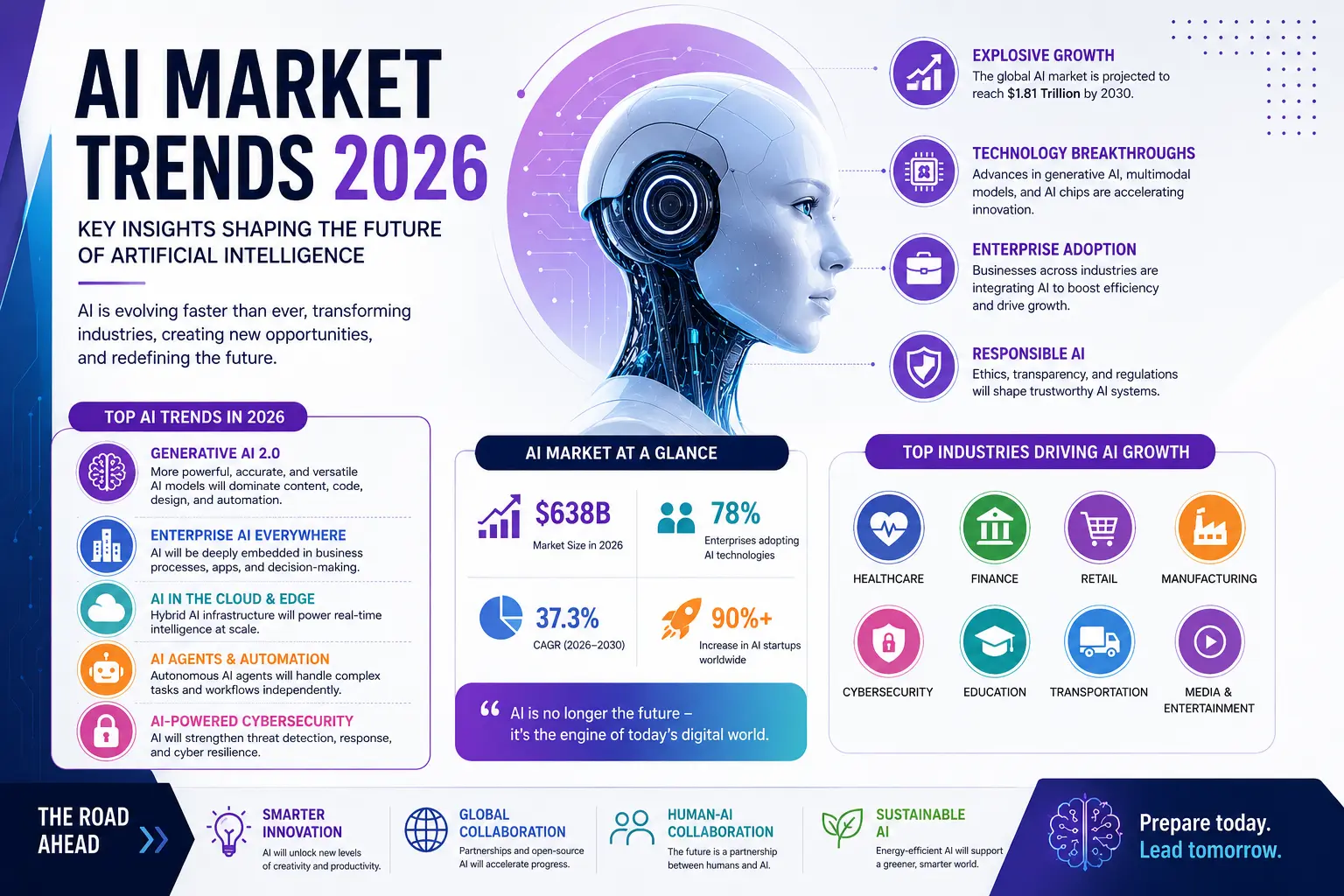
Explore AI market trends 2026, including enterprise adoption, generative AI, investments, cybersecurity, regulations, and future industry growth.
Introduction
Artificial intelligence is no longer a futuristic concept—it has become one of the most influential technologies driving global innovation, economic growth, and business transformation. As organizations increasingly integrate AI into their operations, products, and services, understanding AI market trends 2026 is essential for business leaders, investors, developers, and technology enthusiasts.
The AI industry is experiencing unprecedented expansion fueled by advancements in generative AI, machine learning, cloud computing, cybersecurity, automation, and intelligent analytics. Companies across healthcare, finance, retail, manufacturing, education, and cybersecurity are investing heavily in AI solutions to improve efficiency, reduce costs, and gain competitive advantages.
At the same time, governments worldwide are introducing AI regulations, investors are funding next-generation startups, and enterprises are rapidly deploying AI-powered systems at scale.
This comprehensive guide examines the most important AI market trends 2026, including industry growth drivers, investment patterns, emerging technologies, enterprise adoption, regulatory developments, and future opportunities shaping the artificial intelligence ecosystem.
Understanding the AI Market in 2026
The AI market has evolved from a niche technology segment into a central pillar of digital transformation.
Why AI Is Growing So Rapidly
Several factors are accelerating AI adoption worldwide:
- Improved computing power
- Growth of cloud infrastructure
- Advances in machine learning models
- Increased data availability
- Demand for automation
- Enterprise digital transformation initiatives
Organizations increasingly recognize AI as a strategic asset rather than an experimental technology.
AI’s Expanding Economic Impact
Artificial intelligence is influencing:
- Productivity growth
- Business innovation
- Workforce transformation
- Consumer experiences
- Global competitiveness
Many economists consider AI one of the most important technological shifts since the rise of the internet.
Top AI Market Trends 2026
Generative AI Continues Market Dominance
Generative AI remains one of the strongest drivers behind current AI growth.
Key Applications
Generative AI supports:
- Content creation
- Software development
- Customer service
- Marketing automation
- Product design
- Business intelligence
Why It Matters
Organizations are increasingly using generative AI to reduce manual work and accelerate innovation.
Real-World Example
Businesses now use AI assistants to:
- Draft reports
- Create marketing campaigns
- Generate software code
- Summarize meetings
This significantly improves productivity.
Enterprise AI Adoption Reaches New Levels
Enterprise deployment is among the most important AI market trends 2026.
Areas of Adoption
Organizations are implementing AI in:
- Customer support
- Supply chain management
- Human resources
- Finance
- Cybersecurity
- Operations management
Benefits
Companies report improvements in:
- Efficiency
- Decision-making
- Revenue growth
- Cost optimization
AI is increasingly becoming a core business capability.
AI Infrastructure Investments Surge
AI requires substantial computing resources.
Major Investment Areas
Technology companies are investing heavily in:
- AI data centers
- Graphics Processing Units (GPUs)
- AI accelerators
- Cloud infrastructure
- High-performance computing systems
Industry Impact
Infrastructure providers are becoming critical players in the AI economy.
Organizations capable of supporting large-scale AI workloads are gaining competitive advantages.
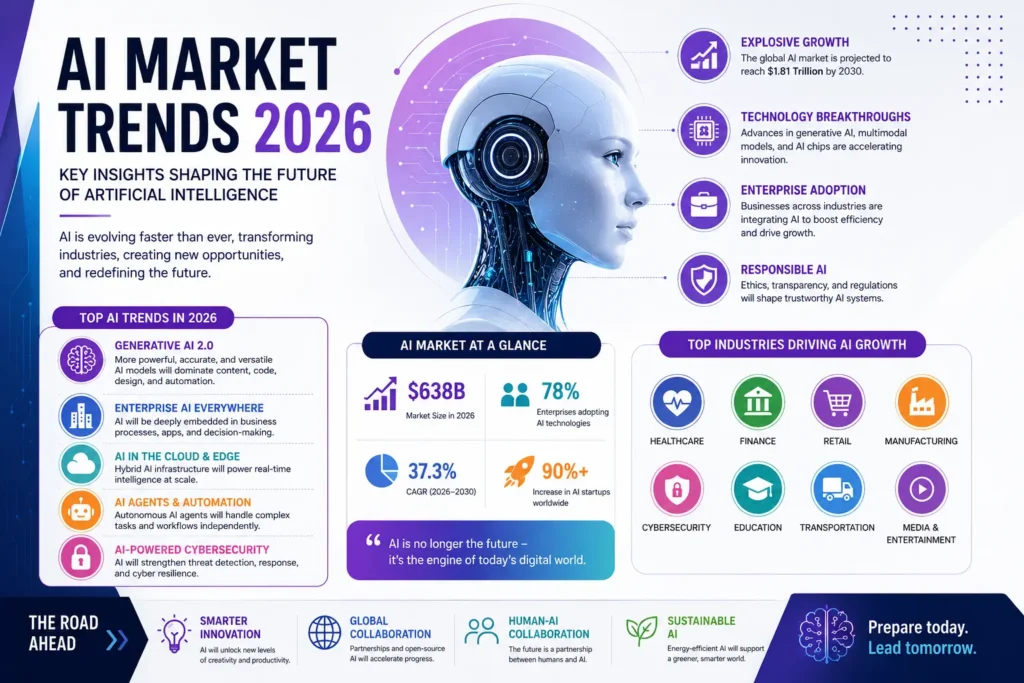
Growth of AI in Key Industries
Healthcare AI Expansion
Healthcare continues to be one of the fastest-growing AI sectors.
Applications
AI supports:
- Medical diagnostics
- Drug discovery
- Patient monitoring
- Clinical decision support
- Personalized medicine
Market Impact
Healthcare providers are using AI to improve patient outcomes while reducing operational costs.
Financial Services Transformation
Banks and financial institutions increasingly rely on AI.
Common Uses
- Fraud detection
- Credit scoring
- Risk management
- Customer support
- Algorithmic trading
Benefits
AI improves accuracy, efficiency, and security across financial operations.
Manufacturing Automation
Smart manufacturing continues expanding through AI-powered systems.
Key Technologies
- Predictive maintenance
- Robotics
- Quality control
- Supply chain optimization
Industry Benefits
Manufacturers achieve:
- Reduced downtime
- Improved efficiency
- Better resource utilization
Retail Personalization
Retailers leverage AI to create highly personalized customer experiences.
Applications
- Product recommendations
- Demand forecasting
- Dynamic pricing
- Inventory management
These capabilities improve customer satisfaction and profitability.
AI Investment and Funding Trends
Venture Capital Activity Remains Strong
Investors continue pouring capital into AI startups.
Popular Investment Categories
- Generative AI
- AI cybersecurity
- Healthcare AI
- Robotics
- Enterprise automation
- AI infrastructure
Why Investors Are Interested
AI startups offer:
- High growth potential
- Scalability
- Industry disruption opportunities
Many venture capital firms now prioritize AI-focused portfolios.
Corporate AI Investments Increase
Large enterprises are expanding internal AI initiatives.
Focus Areas
Organizations invest in:
- Proprietary AI models
- AI talent acquisition
- AI infrastructure
- Employee training
This reflects AI’s growing strategic importance.
AI and Cybersecurity Market Growth
Cybersecurity remains one of the fastest-growing AI applications.
AI-Powered Threat Detection
Organizations use AI to identify:
- Malware
- Phishing attacks
- Insider threats
- Network anomalies
Benefits
AI provides:
- Faster detection
- Improved accuracy
- Automated responses
AI Security Market Expansion
Growing cyber threats continue driving demand for AI cybersecurity solutions.
Businesses increasingly invest in:
- Extended Detection and Response (XDR)
- Security Information and Event Management (SIEM)
- Network Detection and Response (NDR)
- Threat intelligence platforms
Emerging Technologies Driving AI Market Growth
Multimodal AI
Multimodal systems process multiple data types simultaneously.
Supported Inputs
- Text
- Images
- Audio
- Video
Benefits
These systems provide more natural interactions and broader functionality.
AI Agents
AI agents represent a major emerging market segment.
Capabilities
AI agents can:
- Execute tasks
- Conduct research
- Manage workflows
- Automate business processes
Market Potential
Many analysts consider AI agents the next major evolution beyond traditional chatbots.
Edge AI
Edge AI processes data directly on devices rather than relying entirely on cloud infrastructure.
Advantages
- Faster responses
- Enhanced privacy
- Reduced bandwidth requirements
This trend is particularly important for smart devices and IoT ecosystems.
Comparison Table: Major AI Market Segments in 2026
| Market Segment | Growth Potential | Key Applications |
|---|---|---|
| Generative AI | Very High | Content, Coding, Automation |
| Healthcare AI | Very High | Diagnostics, Drug Discovery |
| AI Cybersecurity | Very High | Threat Detection, Security |
| Enterprise AI | High | Operations, Analytics |
| Robotics & Automation | High | Manufacturing, Logistics |
| Edge AI | High | Smart Devices, IoT |
| AI Infrastructure | Very High | Data Centers, GPUs |
| AI Agents | Emerging High Growth | Workflow Automation |
Government Regulations and AI Governance
Regulation is becoming increasingly important.
Why Governments Are Acting
Concerns include:
- Data privacy
- AI bias
- Transparency
- National security
- Consumer protection
Emerging Regulatory Trends
AI Risk Management
Organizations must evaluate potential risks associated with AI systems.
Transparency Requirements
Companies may need to disclose AI-generated content.
Accountability Standards
Businesses increasingly face expectations regarding responsible AI usage.
Strong governance frameworks are becoming essential for long-term AI adoption.
Benefits of AI Market Growth
Increased Productivity
AI automates repetitive tasks and improves operational efficiency.
Faster Innovation
Organizations can develop products and services more rapidly.
Enhanced Decision-Making
AI analyzes large datasets and generates actionable insights.
Economic Growth
AI contributes to job creation, investment, and business expansion.
Improved Customer Experiences
Personalized services improve satisfaction and engagement.
Better Cybersecurity
AI strengthens threat detection and incident response.
Competitive Advantages
Organizations adopting AI effectively gain strategic benefits.
Challenges and Limitations
Despite strong growth, the AI market faces challenges.
Data Privacy Concerns
AI systems often require significant amounts of user data.
High Infrastructure Costs
Training and deploying advanced models can be expensive.
Talent Shortages
Demand for AI professionals continues exceeding supply.
Ethical Concerns
Issues include:
- Bias
- Fairness
- Transparency
- Accountability
Regulatory Complexity
Organizations must navigate evolving compliance requirements.
Security Risks
AI systems can become targets of cyberattacks and manipulation.
Industry Insights and Expert Analysis
Several observations define the current AI landscape.
AI Is Becoming Essential Infrastructure
Businesses increasingly view AI as a foundational technology.
Enterprise Demand Is Outpacing Consumer Growth
Most AI spending currently originates from organizations rather than individual consumers.
Competition Is Intensifying
Technology giants, startups, and governments are competing aggressively for AI leadership.
AI Ecosystems Matter More Than Individual Models
Success increasingly depends on:
- Infrastructure
- Data quality
- Integration capabilities
- User adoption
rather than model performance alone.
Future Trends Beyond 2026
Autonomous AI Systems
Future AI systems will manage increasingly complex workflows independently.
Human-AI Collaboration
Organizations will focus on combining human expertise with AI capabilities.
Personalized AI Experiences
AI assistants will become more context-aware and adaptive.
AI-Powered Scientific Research
AI will continue accelerating discoveries in medicine, climate science, and engineering.
Quantum-AI Integration
The convergence of AI and quantum computing may unlock new computational capabilities.
Global AI Regulation Expansion
Governments are expected to introduce more comprehensive AI policies.
FAQ
1. What are the biggest AI market trends 2026?
Major trends include generative AI growth, enterprise adoption, AI infrastructure investment, AI cybersecurity expansion, healthcare innovation, and AI agents.
2. Why is the AI market growing so quickly?
The market is growing due to improved computing power, cloud infrastructure, data availability, automation demand, and strong enterprise adoption.
3. Which industries are investing most heavily in AI?
Healthcare, finance, cybersecurity, manufacturing, retail, and enterprise software are among the leading sectors.
4. What role does generative AI play in market growth?
Generative AI drives productivity improvements, content creation, software development, and business automation.
5. How are governments regulating AI?
Governments are introducing regulations focused on transparency, privacy, risk management, accountability, and security.
6. What are AI agents?
AI agents are intelligent systems capable of executing tasks, managing workflows, and making decisions with minimal human intervention.
7. What challenges could slow AI market growth?
Challenges include privacy concerns, infrastructure costs, talent shortages, ethical issues, cybersecurity risks, and regulatory uncertainty.
Conclusion
The AI market trends 2026 reveal an industry experiencing remarkable growth and transformation. Generative AI, enterprise adoption, infrastructure investments, cybersecurity solutions, healthcare innovations, and emerging AI agents are driving the next phase of artificial intelligence development.
Organizations that understand these trends will be better positioned to capitalize on new opportunities, improve operational efficiency, and maintain competitive advantages in an increasingly AI-driven economy. While challenges related to regulation, ethics, security, and talent remain important considerations, the long-term outlook for artificial intelligence remains exceptionally strong.
As AI continues to evolve, its influence will extend deeper into every industry, making it one of the defining technologies of the coming decade.
Key Takeaways
- AI market trends 2026 show continued rapid growth across industries.
- Generative AI remains a primary driver of innovation and investment.
- Enterprise AI adoption is accelerating worldwide.
- AI infrastructure spending is reaching record levels.
- Healthcare and cybersecurity are among the fastest-growing AI sectors.
- AI agents represent a major emerging market opportunity.
- Governments are increasing focus on AI governance and regulation.
- Edge AI is expanding across smart devices and IoT ecosystems.
- Talent shortages and privacy concerns remain significant challenges.
- AI is becoming a foundational technology for future economic growth and digital transformation.
