
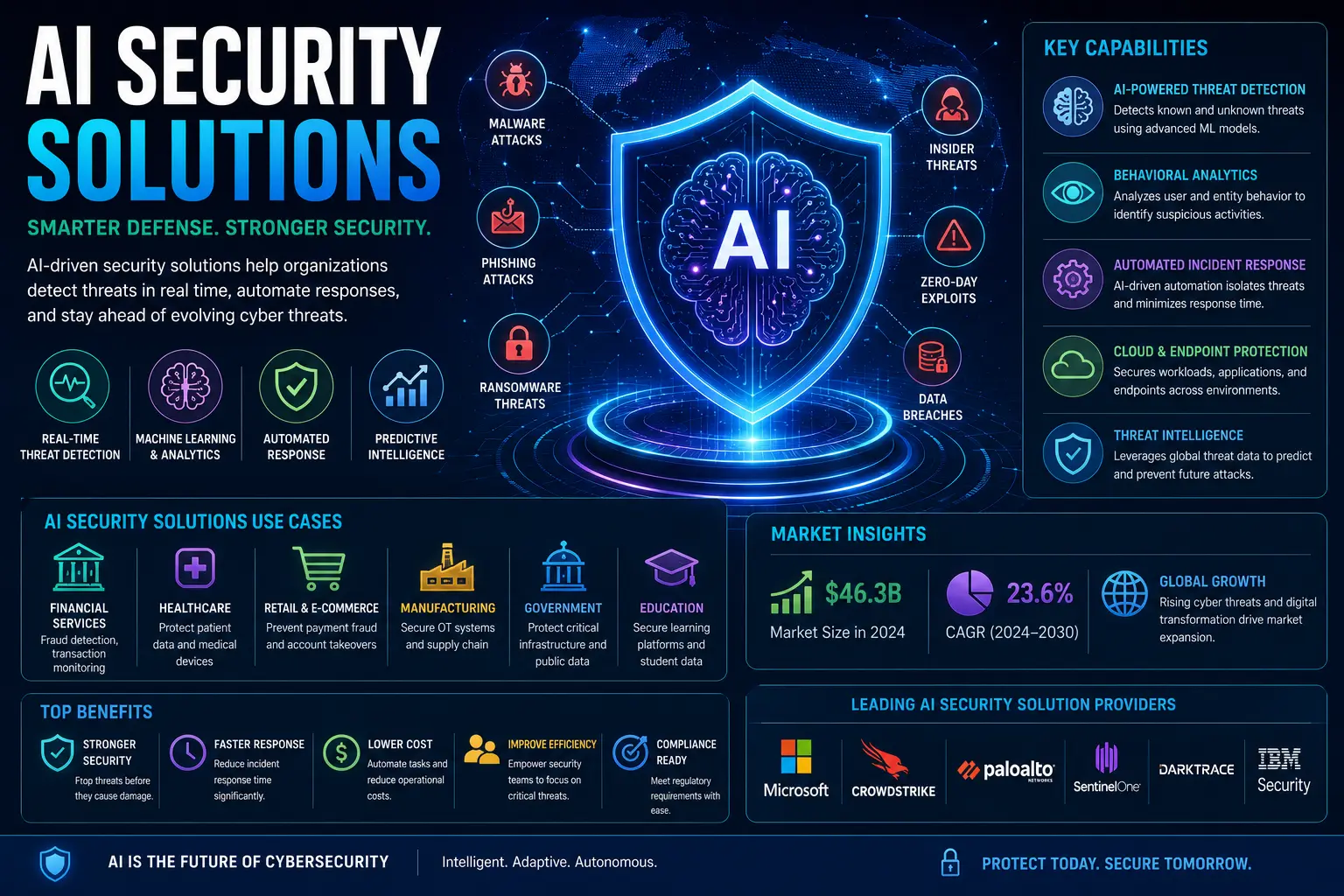
Discover how AI security solutions improve threat detection, automate cyber defense, prevent attacks, and strengthen business cybersecurity in 2026.
Introduction
Cybersecurity threats are evolving faster than ever. Organizations face a growing number of cyberattacks, including ransomware, phishing campaigns, insider threats, account takeovers, data breaches, and sophisticated nation-state attacks. Traditional security tools often struggle to keep up with the speed, complexity, and scale of modern threats.
This is where AI security solutions are transforming cybersecurity. By leveraging artificial intelligence, machine learning, behavioral analytics, and automation, businesses can detect threats in real time, respond to incidents faster, and reduce the workload on security teams.
AI-powered security systems continuously analyze vast amounts of data, identify suspicious activities, and adapt to emerging threats. Unlike traditional rule-based systems, AI learns from patterns and improves over time, making it one of the most powerful tools in modern cyber defense.
This comprehensive guide explores AI security solutions, how they work, key technologies, business applications, benefits, challenges, industry trends, and the future of AI-driven cybersecurity.
What Are AI Security Solutions?
AI security solutions are cybersecurity technologies that use artificial intelligence and machine learning to identify, analyze, prevent, and respond to security threats.
These solutions monitor:
- Network traffic
- User behavior
- Endpoint activity
- Cloud environments
- Applications
- Identity systems
AI enables organizations to move beyond reactive security and adopt proactive threat prevention strategies.
Core Objectives of AI Security Solutions
AI security tools are designed to:
- Detect threats faster
- Reduce false positives
- Automate security operations
- Improve incident response
- Enhance visibility across environments
- Predict future risks
Why AI Is Becoming Essential for Cybersecurity
Modern organizations generate enormous amounts of security data.
Growing Threat Landscape
Businesses face threats such as:
- Ransomware
- Malware
- Phishing
- Insider attacks
- Credential theft
- Advanced Persistent Threats (APTs)
Manual analysis alone is no longer sufficient.
Security Talent Shortage
Many organizations struggle to hire qualified cybersecurity professionals.
AI helps bridge this gap by automating repetitive tasks.
Increasing Attack Sophistication
Cybercriminals increasingly use:
- Automation
- AI-generated phishing
- Deepfake technology
- Advanced malware
Defenders need equally advanced tools.
How AI Security Solutions Work
AI security platforms follow a structured process.
Data Collection
Security systems gather information from:
- Endpoints
- Firewalls
- Networks
- Applications
- Cloud platforms
- Identity systems
Behavioral Analysis
AI establishes normal patterns for:
- Users
- Devices
- Applications
- Network traffic
Threat Detection
Machine learning identifies suspicious activities and anomalies.
Risk Assessment
The system evaluates:
- Severity
- Likelihood
- Business impact
Automated Response
AI can:
- Block malicious activity
- Isolate compromised devices
- Disable accounts
- Trigger alerts
Key Technologies Behind AI Security Solutions
Machine Learning
Machine learning enables systems to learn from historical data and improve detection accuracy.
Benefits
- Continuous improvement
- Threat prediction
- Adaptive security
Deep Learning
Deep learning processes complex datasets and identifies sophisticated attack patterns.
Applications
- Malware detection
- Fraud prevention
- Threat intelligence
Behavioral Analytics
Behavioral analytics helps detect unusual activities.
Examples
- Unusual login behavior
- Abnormal file access
- Suspicious data transfers
Natural Language Processing (NLP)
NLP assists with:
- Threat intelligence analysis
- Security reporting
- Incident investigation
Predictive Analytics
AI forecasts future risks based on current and historical data.
Types of AI Security Solutions
AI-Powered Threat Detection
Threat detection remains one of the most common AI applications.
Capabilities
- Malware identification
- Intrusion detection
- Suspicious behavior analysis
Benefits
Organizations detect threats faster than traditional methods.
Endpoint Security
Endpoints remain primary attack targets.
Protected Assets
- Computers
- Smartphones
- Servers
- Tablets
AI Features
- Behavioral monitoring
- Ransomware detection
- Automated remediation
Network Security Monitoring
AI continuously monitors network traffic.
Functions
- Traffic analysis
- Anomaly detection
- Threat hunting
Example
AI identifies unusual communication between devices that may indicate malware activity.
Cloud Security
Cloud adoption continues growing.
AI Helps Secure
- SaaS applications
- Cloud workloads
- Multi-cloud environments
Security Functions
- Misconfiguration detection
- Risk monitoring
- Access control
Identity and Access Management (IAM)
Identity is a major attack target.
AI Enhancements
- Adaptive authentication
- Behavioral biometrics
- Continuous verification
Leading AI Security Solutions in the Market
Microsoft Defender XDR
Provides AI-powered protection across:
- Endpoints
- Identities
- Cloud environments
Strengths
- Threat correlation
- Automated investigations
- Enterprise integration
CrowdStrike Falcon
Known for AI-driven endpoint security.
Features
- Threat detection
- Threat hunting
- Incident response
Palo Alto Cortex XDR
Combines AI and behavioral analytics.
Capabilities
- Network visibility
- Threat investigation
- Automated response
SentinelOne
Offers autonomous endpoint protection.
Benefits
- AI-driven detection
- Automated remediation
- Real-time monitoring
Darktrace
Uses self-learning AI for cyber defense.
Strengths
- Anomaly detection
- Autonomous response
- Threat visibility
Comparison Table: Traditional vs AI Security Solutions
| Feature | Traditional Security | AI Security Solutions |
|---|---|---|
| Detection Method | Rule-Based | Behavioral & Predictive |
| Threat Adaptability | Limited | High |
| Real-Time Monitoring | Moderate | Advanced |
| Automation | Low | High |
| False Positives | Higher | Lower |
| Unknown Threat Detection | Limited | Strong |
| Scalability | Moderate | Excellent |
Real-World Applications of AI Security Solutions
Financial Services
Banks use AI to:
- Detect fraud
- Monitor transactions
- Prevent account compromise
Healthcare
Healthcare providers secure:
- Patient records
- Medical devices
- Healthcare networks
Retail
Retailers use AI to prevent:
- Payment fraud
- Credential theft
- Data breaches
Manufacturing
AI protects:
- Industrial systems
- Connected devices
- Operational technology
Government
Public agencies use AI to secure critical infrastructure and sensitive data.
Benefits of AI Security Solutions
Faster Threat Detection
AI identifies threats within seconds.
Reduced False Positives
Machine learning improves alert accuracy.
Continuous Monitoring
AI operates 24/7 without interruption.
Improved Incident Response
Automation accelerates containment and remediation.
Enhanced Visibility
Organizations gain deeper insight into their security environments.
Lower Operational Costs
Automation reduces manual workloads.
Proactive Defense
Predictive analytics helps prevent attacks before they occur.
Industry Trends Driving AI Security Solutions
Extended Detection and Response (XDR)
XDR platforms integrate:
- Endpoint security
- Network monitoring
- Cloud security
- Identity protection
into a unified solution.
AI Security Copilots
Generative AI assistants help analysts:
- Investigate threats
- Summarize incidents
- Generate reports
Zero Trust Security
AI strengthens Zero Trust architectures through continuous verification.
Autonomous Security Operations
Organizations increasingly automate:
- Threat detection
- Investigations
- Remediation
using AI technologies.
Challenges and Limitations
Privacy Concerns
AI systems often process sensitive information.
Organizations must ensure regulatory compliance.
Data Quality Requirements
Poor-quality data reduces AI effectiveness.
Implementation Complexity
Deploying AI security tools requires:
- Expertise
- Integration planning
- Ongoing optimization
Adversarial AI Attacks
Attackers may attempt to manipulate AI systems.
Examples
- Data poisoning
- Model evasion
- Adversarial inputs
Cost Considerations
Advanced AI platforms may require significant investment.
Future Trends in AI Security Solutions
Fully Autonomous Cyber Defense
Future systems may independently:
- Detect threats
- Investigate incidents
- Execute responses
with minimal human intervention.
Predictive Security
AI will increasingly identify threats before attacks occur.
AI-Powered Threat Intelligence
Threat intelligence platforms will become more proactive and accurate.
Deepfake Detection
Organizations will invest heavily in AI tools that detect synthetic media attacks.
Explainable AI
Security teams will demand greater transparency regarding AI decisions.
Quantum-Aware Security
AI will help organizations prepare for future quantum computing risks.
FAQ
1. What are AI security solutions?
AI security solutions use artificial intelligence to detect, analyze, prevent, and respond to cybersecurity threats.
2. How do AI security solutions improve cybersecurity?
They provide real-time monitoring, behavioral analysis, automated responses, and predictive threat detection.
3. Can AI security solutions stop ransomware?
Many AI platforms can identify ransomware behavior early and isolate affected systems before widespread damage occurs.
4. Which industries benefit most from AI security solutions?
Financial services, healthcare, retail, manufacturing, government, and technology companies are major adopters.
5. Are AI security tools suitable for small businesses?
Yes. Many vendors offer scalable solutions designed specifically for small and medium-sized businesses.
6. What are the biggest challenges of AI security solutions?
Common challenges include privacy concerns, implementation complexity, data quality issues, and adversarial attacks.
7. Will AI replace cybersecurity professionals?
No. AI enhances human capabilities by automating repetitive tasks and improving threat visibility, but expert oversight remains essential.
Conclusion
AI security solutions have become a cornerstone of modern cybersecurity strategies. As cyber threats grow more sophisticated, organizations need intelligent technologies capable of detecting, analyzing, and responding to attacks at machine speed.
By combining machine learning, behavioral analytics, automation, and predictive intelligence, AI-powered security platforms help businesses improve protection, reduce operational burdens, and strengthen cyber resilience. While challenges such as privacy, implementation complexity, and evolving threats remain, AI continues to provide significant advantages over traditional security approaches.
Organizations that invest in AI-driven security solutions today will be better prepared to defend against tomorrow’s cyber threats and maintain trust in an increasingly digital world.
Key Takeaways
- AI security solutions use machine learning and automation to improve cybersecurity.
- AI enhances threat detection through behavioral analytics and anomaly detection.
- Endpoint, network, cloud, and identity security are major application areas.
- AI reduces false positives and improves alert prioritization.
- XDR and Zero Trust architectures increasingly rely on AI technologies.
- Financial services, healthcare, retail, and government sectors are major adopters.
- Predictive analytics helps organizations prevent attacks before they occur.
- Privacy concerns and adversarial AI attacks remain challenges.
- Autonomous security operations are becoming more common.
- AI will play a central role in the future of cybersecurity.
