
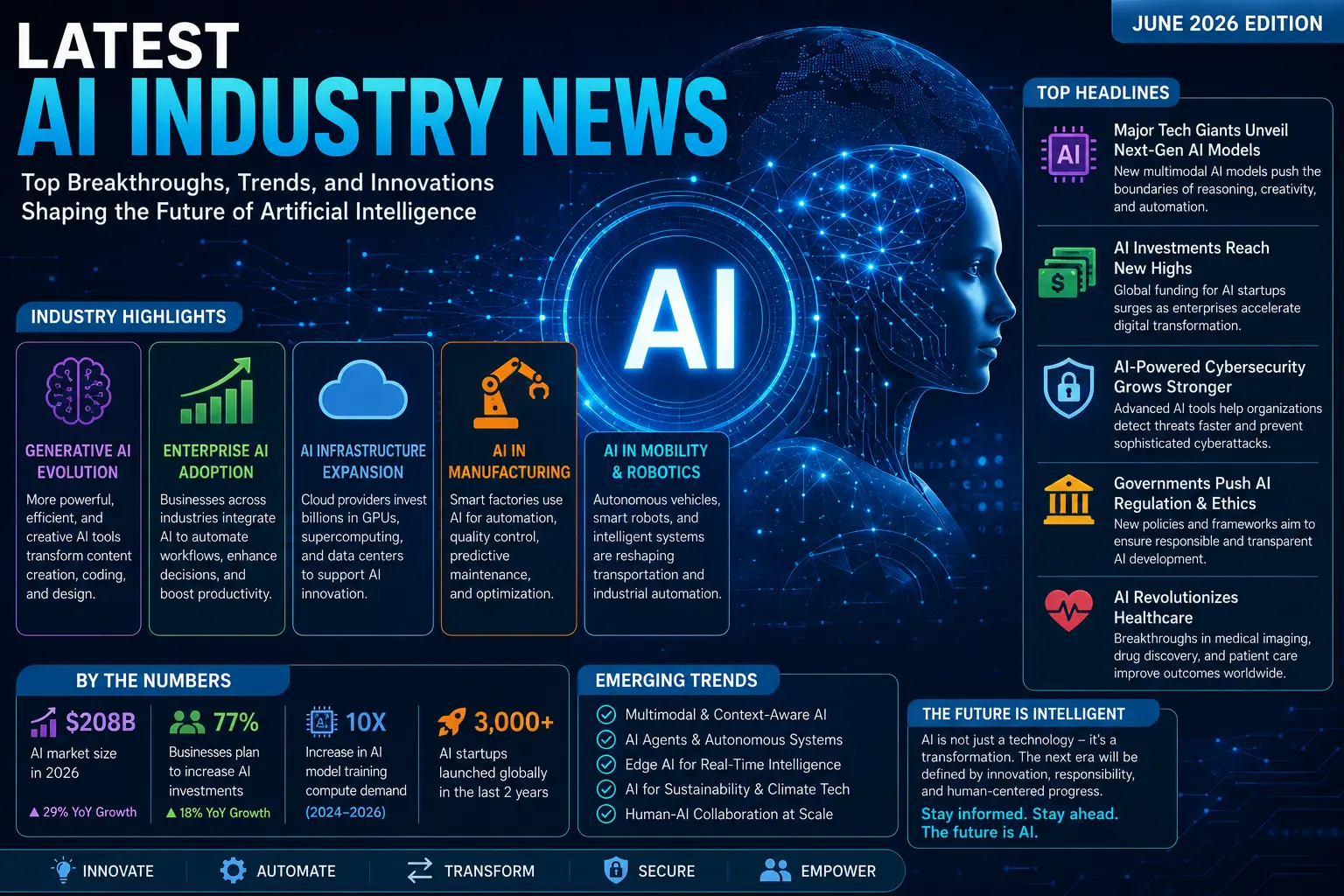
Explore the latest AI industry news, major breakthroughs, market trends, investments, regulations, and innovations shaping artificial intelligence in 2026.
Introduction
Artificial intelligence continues to reshape industries, economies, and daily life at an extraordinary pace. From groundbreaking generative AI models and enterprise automation to healthcare innovations and cybersecurity advancements, the latest AI industry news highlights a rapidly evolving technology landscape that is transforming how businesses operate and how people interact with digital systems.
Over the past few years, AI has moved from an emerging technology to a strategic priority for organizations worldwide. Governments are introducing new regulations, technology giants are investing billions in AI infrastructure, startups are disrupting traditional industries, and enterprises are integrating AI into core business operations.
For technology enthusiasts, business leaders, developers, investors, and cybersecurity professionals, staying informed about AI news is essential for understanding opportunities, risks, and future market developments.
This comprehensive guide explores the most significant developments in the AI industry, including major trends, investment activity, enterprise adoption, regulatory changes, cybersecurity implications, and future innovations expected to shape the next phase of artificial intelligence.
The Current State of the AI Industry
Artificial intelligence has become one of the fastest-growing sectors in the global technology market.
Rapid Market Expansion
Organizations across virtually every industry are investing heavily in AI technologies.
Major sectors adopting AI include:
- Healthcare
- Finance
- Manufacturing
- Retail
- Cybersecurity
- Education
- Transportation
- Media
Analysts continue to project strong growth as businesses seek competitive advantages through automation, predictive analytics, and intelligent decision-making.
Generative AI Remains a Major Growth Driver
Generative AI continues to dominate the latest AI industry news due to its ability to create:
- Text
- Images
- Videos
- Software code
- Audio
- Business content
Organizations are increasingly deploying generative AI solutions to improve productivity and reduce operational costs.
Major Developments in the Latest AI Industry News
Enterprise AI Adoption Accelerates
One of the most important trends is the widespread integration of AI into business operations.
Key Applications
Businesses are using AI for:
- Customer support automation
- Data analysis
- Workflow optimization
- Predictive forecasting
- Marketing personalization
Real-World Example
Many organizations now use AI assistants to summarize meetings, generate reports, and automate routine administrative tasks.
This improves employee productivity and operational efficiency.
AI Infrastructure Investments Reach Record Levels
Technology companies continue investing billions in AI infrastructure.
Areas of Investment
- AI data centers
- High-performance computing
- Advanced GPUs
- Cloud AI platforms
- AI training systems
Why It Matters
Modern AI models require enormous computational resources.
Infrastructure investment is becoming a key competitive advantage.
Expansion of AI in Healthcare
Healthcare remains one of the fastest-growing AI sectors.
Emerging Applications
AI supports:
- Medical imaging
- Drug discovery
- Patient monitoring
- Clinical decision support
- Personalized medicine
Industry Impact
Healthcare providers increasingly use AI to improve diagnostic accuracy and patient outcomes while reducing administrative burdens.
Generative AI Continues to Transform Industries
Generative AI remains at the center of AI innovation.
Content Creation
Businesses use AI tools to generate:
- Blog articles
- Marketing campaigns
- Product descriptions
- Social media content
Software Development
AI coding assistants help developers:
- Write code
- Debug applications
- Generate documentation
- Improve productivity
Design and Media
Creative professionals use AI for:
- Graphic design
- Video production
- Audio generation
- Digital content creation
Benefits
Generative AI significantly reduces production time and costs.
AI and Cybersecurity: A Growing Focus
Cybersecurity continues to be a major area of AI investment.
AI-Powered Threat Detection
Organizations use AI to identify:
- Malware
- Phishing attacks
- Insider threats
- Network anomalies
Advantages
AI enables:
- Faster detection
- Improved accuracy
- Automated responses
AI-Powered Cyber Threats
The latest AI industry news also highlights growing concerns regarding AI-enabled cyberattacks.
Examples
Cybercriminals increasingly use AI for:
- Advanced phishing campaigns
- Deepfake creation
- Automated reconnaissance
- Social engineering attacks
This has intensified demand for AI-driven defense solutions.
Government Regulations and AI Governance
Regulation has become a major focus within the AI industry.
Why Regulation Is Increasing
Governments are addressing concerns related to:
- Data privacy
- AI bias
- Transparency
- National security
- Intellectual property
Key Regulatory Priorities
Transparency
Organizations may be required to disclose AI-generated content.
Risk Management
Companies must increasingly demonstrate responsible AI practices.
Security Requirements
AI systems are facing stricter cybersecurity standards.
Ethical Development
Governments continue promoting ethical AI frameworks.
AI Startups and Venture Capital Activity
Startup innovation remains a powerful force within the AI ecosystem.
Areas Attracting Investment
Investors are funding startups focused on:
- Generative AI
- Robotics
- Cybersecurity
- Healthcare AI
- Enterprise automation
- AI infrastructure
Why Investors Are Interested
AI offers opportunities for:
- Productivity gains
- Market disruption
- Cost reduction
- New business models
Many AI startups are achieving rapid growth and attracting significant funding rounds.
AI Industry Comparison Table
| Sector | AI Applications | Growth Potential |
|---|---|---|
| Healthcare | Diagnostics, Drug Discovery | Very High |
| Cybersecurity | Threat Detection, Response | Very High |
| Finance | Fraud Detection, Analytics | High |
| Manufacturing | Automation, Predictive Maintenance | High |
| Retail | Personalization, Forecasting | High |
| Education | Adaptive Learning | Moderate to High |
| Transportation | Autonomous Systems | High |
| Media & Content | Generative AI | Very High |
Emerging Technologies Driving AI Innovation
Multimodal AI
Multimodal systems can process:
- Text
- Images
- Audio
- Video
simultaneously.
Benefits
These systems provide more natural and comprehensive interactions.
AI Agents
AI agents are becoming increasingly capable of:
- Planning tasks
- Executing workflows
- Managing schedules
- Performing research
Business Impact
AI agents may dramatically improve productivity across industries.
Edge AI
Edge AI processes information directly on devices rather than relying entirely on cloud computing.
Advantages
- Lower latency
- Enhanced privacy
- Reduced bandwidth usage
This trend is particularly important for smart devices and IoT ecosystems.
Benefits of Recent AI Industry Developments
Increased Productivity
AI automates repetitive tasks and accelerates workflows.
Improved Decision-Making
Organizations gain actionable insights from large datasets.
Cost Optimization
Automation reduces operational expenses.
Enhanced Customer Experiences
AI enables more personalized interactions.
Faster Innovation
Businesses can develop products and services more rapidly.
Better Cybersecurity
AI improves threat detection and incident response capabilities.
New Economic Opportunities
AI is creating entirely new industries and career paths.
Challenges and Limitations
Despite rapid progress, significant challenges remain.
Data Privacy Concerns
AI systems often require access to large amounts of data.
Ethical Issues
Concerns include:
- Bias
- Fairness
- Transparency
- Accountability
Workforce Disruption
Automation may impact certain job categories.
High Infrastructure Costs
Training advanced AI models requires significant investment.
Regulatory Uncertainty
Organizations must navigate evolving legal requirements.
Security Risks
AI systems themselves can become targets of cyberattacks.
Industry Insights and Expert Analysis
Several key observations are emerging across the AI landscape.
AI Is Becoming a Business Necessity
Organizations increasingly view AI as a strategic requirement rather than an optional technology.
Enterprise Adoption Is Outpacing Consumer Adoption
Businesses are deploying AI at scale to improve efficiency and competitiveness.
AI Governance Is Becoming Essential
Responsible AI frameworks are increasingly important for maintaining trust and regulatory compliance.
Competition Is Intensifying
Technology giants, startups, and governments are competing aggressively to establish AI leadership.
Future Trends in the AI Industry
Autonomous AI Systems
Future AI systems will perform increasingly complex tasks independently.
Potential Applications
- Business operations
- Research assistance
- Customer support
- Cybersecurity
AI-Powered Scientific Discovery
AI will continue accelerating breakthroughs in:
- Medicine
- Materials science
- Climate research
- Biotechnology
Personalized AI Experiences
Future AI assistants will become more context-aware and personalized.
Quantum-AI Integration
The combination of quantum computing and AI may unlock new computational capabilities.
Stronger AI Regulations
Governments will likely introduce more comprehensive AI governance frameworks.
Human-AI Collaboration
Rather than replacing workers entirely, AI will increasingly act as a collaborative partner.
FAQ
1. What is the latest AI industry news focused on?
Current AI industry developments focus on generative AI, enterprise adoption, cybersecurity, healthcare innovation, infrastructure investment, and regulatory changes.
2. Why is generative AI receiving so much attention?
Generative AI can create text, images, videos, code, and other content, making it valuable across many industries and use cases.
3. How is AI impacting businesses?
AI helps businesses automate tasks, improve decision-making, reduce costs, enhance customer experiences, and increase productivity.
4. What industries are adopting AI the fastest?
Healthcare, cybersecurity, finance, manufacturing, retail, and enterprise software are among the fastest-growing AI sectors.
5. What are the biggest concerns surrounding AI?
Major concerns include privacy, bias, security risks, misinformation, workforce disruption, and regulatory compliance.
6. Is AI creating new jobs?
Yes. AI is generating demand for specialists in machine learning, cybersecurity, AI governance, prompt engineering, data science, and related fields.
7. What should businesses do to prepare for AI adoption?
Businesses should develop AI strategies, invest in workforce training, establish governance policies, and prioritize cybersecurity and data protection.
Conclusion
The latest AI industry news demonstrates that artificial intelligence is no longer an emerging technology—it is a transformative force reshaping industries, economies, and society. From generative AI and enterprise automation to healthcare innovation and advanced cybersecurity solutions, AI continues to create new opportunities while introducing new challenges.
Organizations that stay informed about AI developments will be better positioned to capitalize on innovation, improve competitiveness, and navigate evolving regulatory landscapes. At the same time, responsible AI deployment, cybersecurity preparedness, and strong governance frameworks will remain critical for long-term success.
As artificial intelligence continues to evolve throughout 2026 and beyond, its influence will extend even further into business operations, scientific research, consumer technology, and everyday life.
Key Takeaways
- Latest AI industry news highlights rapid growth in enterprise AI adoption.
- Generative AI remains one of the most influential technology trends.
- AI infrastructure investments continue reaching record levels.
- Healthcare and cybersecurity are among the fastest-growing AI sectors.
- Governments are increasing focus on AI regulation and governance.
- AI startups continue attracting significant venture capital investment.
- Multimodal AI and AI agents are emerging as major innovation areas.
- Privacy, ethics, and security remain important industry challenges.
- Businesses increasingly view AI as a strategic necessity.
- Human-AI collaboration will shape the future of work and innovation.
