
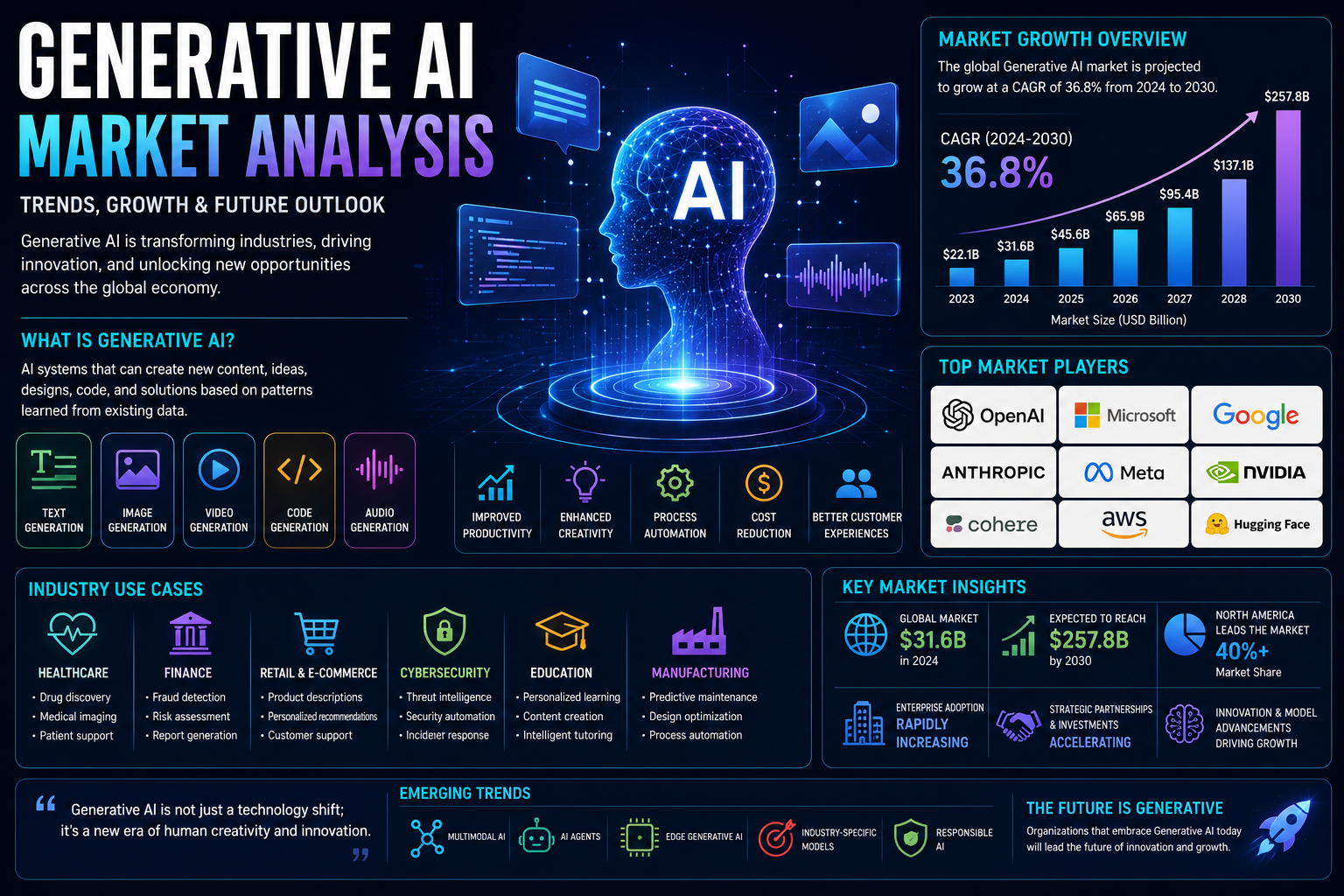
Explore a comprehensive generative AI market analysis covering industry growth, key players, investment trends, opportunities, challenges, and future forecasts.
Introduction
The rise of generative artificial intelligence has become one of the most significant technological developments of the decade. From AI chatbots and content creation tools to software development assistants and enterprise automation platforms, generative AI is transforming how individuals and organizations work, create, and innovate.
A detailed generative AI market analysis reveals an industry experiencing explosive growth, fueled by rapid advancements in large language models (LLMs), multimodal AI systems, cloud infrastructure, and enterprise adoption. Businesses across healthcare, finance, cybersecurity, education, retail, and manufacturing are integrating generative AI solutions to improve efficiency, reduce costs, and gain competitive advantages.
The market is attracting unprecedented levels of investment from venture capital firms, technology giants, governments, and enterprises. As generative AI capabilities continue to improve, industry analysts expect its economic impact to expand significantly over the next decade.
This comprehensive analysis examines the current state of the generative AI market, key growth drivers, major industry players, investment trends, business opportunities, challenges, and future developments shaping the AI landscape in 2026 and beyond.
What Is Generative AI?
Generative AI refers to artificial intelligence systems capable of creating new content based on patterns learned from existing data.
Types of Content Generated
Modern generative AI systems can create:
- Text
- Images
- Videos
- Audio
- Software code
- Designs
- Simulations
Unlike traditional AI systems that primarily analyze data, generative AI creates entirely new outputs.
Core Technologies Behind Generative AI
Large Language Models (LLMs)
LLMs power many modern AI assistants and content-generation tools.
Deep Learning
Deep learning enables AI systems to recognize complex patterns and generate realistic outputs.
Neural Networks
Advanced neural network architectures form the foundation of generative AI systems.
Multimodal AI
Multimodal models process multiple forms of information simultaneously, including text, images, audio, and video.
Generative AI Market Overview
The generative AI market has evolved from a research-driven sector into a major commercial industry.
Rapid Market Expansion
Organizations worldwide are adopting generative AI technologies at an unprecedented pace.
Primary Growth Drivers
- Enterprise digital transformation
- Productivity optimization
- Cloud computing adoption
- AI infrastructure improvements
- Increased data availability
Business Impact
Companies increasingly view generative AI as a strategic technology capable of transforming operations and customer experiences.
Why Businesses Are Investing
Organizations invest in generative AI to:
- Improve efficiency
- Reduce costs
- Accelerate innovation
- Enhance customer service
- Automate workflows
These benefits are driving widespread adoption across industries.
Key Growth Drivers in the Generative AI Market
Enterprise Adoption
Enterprise adoption remains one of the strongest growth factors.
Business Applications
Generative AI supports:
- Customer support
- Content creation
- Software development
- Data analysis
- Marketing automation
Productivity Gains
Organizations report significant improvements in operational efficiency after implementing AI-powered solutions.
Increasing AI Infrastructure Investment
Generative AI requires substantial computing resources.
Infrastructure Components
- AI data centers
- High-performance GPUs
- Cloud platforms
- AI accelerators
Technology companies continue investing billions of dollars to expand AI infrastructure capacity.
Growing Demand for Automation
Businesses increasingly seek solutions that automate repetitive tasks.
Examples
- Report generation
- Customer inquiries
- Coding assistance
- Knowledge management
Generative AI helps organizations achieve these goals at scale.
Expansion of Cloud AI Services
Cloud providers are making generative AI more accessible.
Benefits
- Lower deployment costs
- Scalability
- Easier integration
- Faster implementation
This trend is accelerating adoption among small and medium-sized businesses.
Major Segments of the Generative AI Market
Text Generation
Text generation remains the largest segment.
Common Applications
- Chatbots
- Virtual assistants
- Content creation
- Customer support
Market Impact
Text-based AI tools are transforming communication and productivity across industries.
Image Generation
Image generation tools continue gaining popularity.
Use Cases
- Graphic design
- Advertising
- Marketing content
- Product visualization
Businesses increasingly use AI-generated visuals to reduce production costs.
Video Generation
Video AI is emerging as a high-growth segment.
Applications
- Marketing videos
- Training materials
- Entertainment content
- Social media production
Video generation technologies continue improving rapidly.
Code Generation
AI coding assistants are transforming software development.
Benefits
- Faster coding
- Error reduction
- Documentation assistance
- Developer productivity
This segment is attracting significant enterprise investment.
Leading Companies in the Generative AI Market
OpenAI
OpenAI remains one of the most influential players.
Key Products
- ChatGPT
- GPT models
- Enterprise AI solutions
Market Position
The company continues driving mainstream AI adoption.
Microsoft
Microsoft has integrated generative AI across its ecosystem.
AI Offerings
- Copilot
- Azure AI
- Enterprise productivity tools
Competitive Advantage
Its strong enterprise presence supports rapid adoption.
Google continues expanding its AI portfolio.
Focus Areas
- Search enhancement
- Enterprise AI
- Multimodal systems
Industry Influence
Google remains a major force in AI research and development.
Anthropic
Anthropic has become a significant competitor.
Strengths
- AI safety
- Enterprise applications
- Advanced language models
Meta
Meta is investing heavily in open-source AI development.
Strategic Focus
- Large language models
- AI research
- Open-source ecosystems
Comparison Table: Generative AI Market Segments
| Segment | Growth Potential | Primary Applications |
|---|---|---|
| Text Generation | Very High | Chatbots, Content |
| Image Generation | High | Marketing, Design |
| Video Generation | Very High | Media, Advertising |
| Code Generation | Very High | Software Development |
| Audio Generation | High | Podcasts, Voice Assistants |
| Multimodal AI | Extremely High | Enterprise Solutions |
Industry Applications of Generative AI
Healthcare
Generative AI supports:
- Medical documentation
- Drug discovery
- Research analysis
- Clinical workflows
Benefits
Improved efficiency and accelerated innovation.
Finance
Financial institutions use AI for:
- Report generation
- Risk analysis
- Customer support
- Fraud monitoring
Cybersecurity
AI enhances security operations.
Applications
- Threat intelligence
- Security reporting
- Incident analysis
- Fraud detection
Education
Educational institutions leverage AI for:
- Personalized learning
- Tutoring systems
- Content development
Retail and E-Commerce
Retailers use AI to generate:
- Product descriptions
- Marketing content
- Customer recommendations
Investment Trends in Generative AI
Venture Capital Activity
Generative AI startups continue attracting substantial investment.
Popular Investment Areas
- AI infrastructure
- Enterprise AI
- AI agents
- Healthcare AI
Corporate Investment
Technology companies are investing heavily in:
- AI talent
- Research
- Infrastructure
- Strategic partnerships
Government Support
Governments increasingly fund AI initiatives to strengthen national competitiveness.
Benefits of Generative AI
Increased Productivity
AI automates time-consuming tasks.
Faster Innovation
Organizations can develop products and services more quickly.
Cost Reduction
Automation lowers operational expenses.
Enhanced Creativity
AI assists with idea generation and content development.
Improved Customer Experiences
AI enables personalized interactions at scale.
Scalability
Organizations can deploy AI solutions across multiple departments.
Competitive Advantage
Businesses adopting AI effectively gain market advantages.
Challenges and Limitations
Data Privacy Concerns
Generative AI systems often process large amounts of sensitive information.
Accuracy Issues
AI-generated outputs may contain inaccuracies or hallucinations.
Intellectual Property Questions
Copyright and ownership concerns continue evolving.
Infrastructure Costs
Training advanced models requires significant investment.
Regulatory Uncertainty
Governments continue developing AI governance frameworks.
Security Risks
AI systems can be targeted through:
- Data poisoning
- Model manipulation
- Adversarial attacks
Future Trends in the Generative AI Market
AI Agents
AI agents capable of performing autonomous tasks are expected to become a major growth area.
Applications
- Workflow automation
- Research
- Customer service
Multimodal AI Expansion
Future systems will seamlessly integrate:
- Text
- Images
- Audio
- Video
Benefits
More natural and powerful user experiences.
Industry-Specific AI Models
Specialized models will emerge for:
- Healthcare
- Finance
- Cybersecurity
- Manufacturing
Personalized AI Assistants
Future assistants will become more context-aware and proactive.
Human-AI Collaboration
Organizations will increasingly focus on combining human expertise with AI capabilities.
Explainable AI
Transparency and accountability will become more important for enterprise adoption.
FAQ
1. What is generative AI?
Generative AI refers to artificial intelligence systems that create new content such as text, images, videos, audio, and software code.
2. Why is the generative AI market growing so quickly?
Growth is driven by enterprise adoption, productivity gains, cloud infrastructure improvements, and advancements in AI models.
3. Which industries use generative AI the most?
Healthcare, finance, cybersecurity, retail, education, and software development are among the leading adopters.
4. Who are the major players in the generative AI market?
Key companies include OpenAI, Microsoft, Google, Anthropic, Meta, and several emerging AI startups.
5. What are AI agents?
AI agents are intelligent systems capable of performing tasks, managing workflows, and making decisions with limited human intervention.
6. What challenges does generative AI face?
Major challenges include privacy concerns, accuracy issues, intellectual property questions, regulatory uncertainty, and security risks.
7. What is the future of the generative AI market?
The market is expected to grow through AI agents, multimodal systems, personalized assistants, industry-specific models, and increased enterprise adoption.
Conclusion
This generative AI market analysis highlights an industry experiencing extraordinary growth and transformation. Generative AI is rapidly moving beyond experimental use cases and becoming a foundational technology across business operations, software development, cybersecurity, healthcare, education, and creative industries.
Strong enterprise demand, massive infrastructure investments, continuous innovation, and growing productivity benefits are driving adoption worldwide. While challenges related to privacy, regulation, intellectual property, and security remain important considerations, the long-term outlook for the generative AI market remains exceptionally positive.
Organizations that understand these market dynamics and strategically invest in AI capabilities today will be well-positioned to capitalize on the next wave of digital transformation.
Key Takeaways
- Generative AI market analysis shows strong growth across multiple industries.
- Enterprise adoption remains a primary market driver.
- Text, image, video, and code generation are major market segments.
- OpenAI, Microsoft, Google, Anthropic, and Meta are key industry players.
- AI infrastructure investment continues accelerating.
- Healthcare, finance, cybersecurity, and retail are major adoption sectors.
- AI agents represent a significant future growth opportunity.
- Privacy, regulation, and security remain key challenges.
- Multimodal AI is expected to become increasingly important.
- Generative AI is transforming productivity, innovation, and business operations worldwide.
