
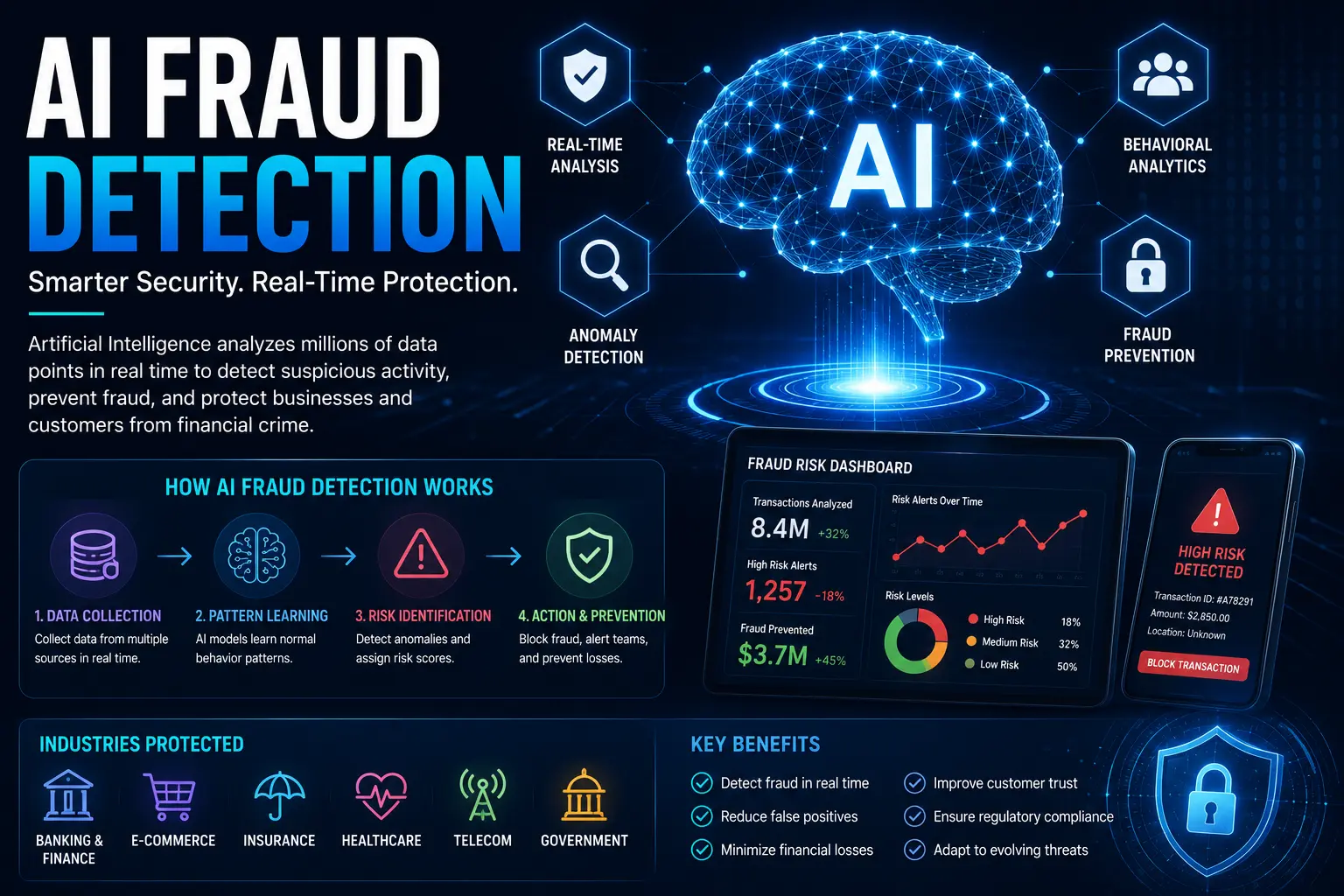
Discover how AI fraud detection helps businesses identify fraud in real time, prevent financial losses, improve security, and enhance customer trust.
Introduction
Fraud is one of the most costly challenges facing businesses, financial institutions, e-commerce platforms, and governments today. As digital transactions continue to grow, cybercriminals are developing increasingly sophisticated methods to bypass traditional security systems. From credit card fraud and identity theft to account takeovers and insurance scams, organizations must constantly adapt to evolving threats.
This is where AI fraud detection is transforming modern security strategies. Artificial intelligence enables organizations to analyze massive volumes of data in real time, identify suspicious patterns, detect anomalies, and stop fraudulent activities before significant damage occurs.
Unlike traditional rule-based systems, AI-powered fraud detection continuously learns from new data and adapts to emerging fraud techniques. This allows businesses to stay ahead of cybercriminals while reducing false positives and improving customer experiences.
In this comprehensive guide, we’ll explore how AI fraud detection works, its applications across industries, benefits, challenges, future trends, and why it has become a critical component of modern fraud prevention strategies.
What Is AI Fraud Detection?
AI fraud detection refers to the use of artificial intelligence technologies such as machine learning, deep learning, behavioral analytics, and predictive modeling to identify, prevent, and investigate fraudulent activities.
AI systems analyze:
- Financial transactions
- User behavior
- Device activity
- Network traffic
- Account activity
- Purchase patterns
These systems can quickly recognize unusual activities that may indicate fraud.
How AI Differs from Traditional Fraud Detection
Traditional fraud detection often relies on predefined rules.
Example
A rule might flag transactions above a specific dollar amount.
While effective in some cases, fraudsters quickly learn to bypass static rules.
AI Advantages
AI can:
- Learn continuously
- Adapt to new fraud methods
- Detect hidden patterns
- Analyze large datasets
- Reduce false positives
This makes AI significantly more effective against modern fraud threats.
Why AI Fraud Detection Is Growing Rapidly
Several factors are driving adoption.
Increase in Digital Transactions
Online banking, mobile payments, and e-commerce continue expanding globally.
More transactions create more opportunities for fraud.
Sophisticated Cybercriminal Techniques
Attackers increasingly use:
- Automation
- AI-generated phishing
- Deepfakes
- Credential theft
- Social engineering
Traditional systems struggle to keep pace.
Rising Financial Losses
Fraud costs organizations billions annually.
Businesses seek technologies that can reduce losses while maintaining customer trust.
Real-Time Security Requirements
Modern organizations need instant fraud detection capabilities.
AI can analyze events within milliseconds.
How AI Fraud Detection Works
AI fraud detection systems follow several key stages.
Data Collection
The system gathers information from multiple sources.
Data Sources
- Transaction records
- User behavior logs
- Device information
- Geolocation data
- Account history
- Network activity
Pattern Recognition
Machine learning models establish normal behavioral patterns.
Examples
Normal behavior may include:
- Typical spending amounts
- Common login locations
- Regular transaction times
Anomaly Detection
AI identifies activities that differ significantly from expected behavior.
Example
A customer typically shops locally but suddenly initiates multiple purchases from another country.
The system flags the activity for review.
Risk Scoring
AI assigns risk scores to transactions.
Higher-risk events receive greater scrutiny.
Automated Response
Organizations may automatically:
- Block transactions
- Request verification
- Freeze accounts
- Alert security teams
Core Technologies Behind AI Fraud Detection
Machine Learning
Machine learning is the foundation of modern fraud detection.
Benefits
- Learns from historical fraud cases
- Identifies evolving threats
- Improves over time
Deep Learning
Deep learning excels at analyzing complex relationships within large datasets.
Applications
- Credit card fraud
- Financial crimes
- Identity theft
Behavioral Analytics
Behavioral analytics evaluates how users interact with systems.
Indicators
- Typing patterns
- Mouse movements
- Login behavior
- Navigation habits
Natural Language Processing (NLP)
NLP helps detect fraud in:
- Customer communications
- Insurance claims
- Financial documents
Predictive Analytics
Predictive models forecast potential fraud risks before attacks occur.
Applications of AI Fraud Detection
Banking and Financial Services
Financial institutions are among the largest adopters of AI fraud detection.
Common Use Cases
- Credit card fraud
- Wire transfer fraud
- Loan fraud
- Account takeover detection
Example
AI can instantly detect unusual spending patterns and block suspicious transactions.
E-Commerce Fraud Prevention
Online retailers face constant fraud threats.
AI Helps Detect
- Payment fraud
- Fake accounts
- Promotional abuse
- Refund fraud
Benefits
Retailers reduce financial losses while improving customer experiences.
Insurance Fraud Detection
Insurance fraud costs billions annually.
AI Applications
- Claims analysis
- Pattern recognition
- Fraud investigation
Example
AI identifies suspicious similarities across multiple claims.
Healthcare Fraud Detection
Healthcare organizations use AI to identify:
- False billing
- Insurance fraud
- Prescription abuse
Benefits
Improved compliance and reduced fraud-related costs.
Telecommunications Fraud
Telecom providers use AI to detect:
- SIM swapping
- Subscription fraud
- Call fraud
Outcome
Faster detection and reduced operational losses.
Comparison Table: Traditional vs AI Fraud Detection
| Feature | Traditional Detection | AI Fraud Detection |
|---|---|---|
| Detection Method | Rule-Based | Machine Learning |
| Adaptability | Limited | High |
| Real-Time Analysis | Limited | Advanced |
| False Positives | Higher | Lower |
| Unknown Fraud Detection | Weak | Strong |
| Scalability | Moderate | High |
| Learning Capability | Static | Continuous |
Real-World Examples of AI Fraud Detection
Credit Card Fraud
Banks use AI to evaluate transactions instantly.
Detection Factors
- Location changes
- Spending behavior
- Merchant risk
- Device information
Online Account Security
AI identifies unusual login activity.
Indicators
- New devices
- Geographic anomalies
- Behavioral deviations
Payment Fraud Prevention
Payment processors use AI to evaluate transaction legitimacy before approval.
Identity Verification
AI helps verify user identities through:
- Biometrics
- Facial recognition
- Behavioral patterns
Benefits of AI Fraud Detection
Faster Fraud Detection
AI analyzes millions of transactions in real time.
Reduced Financial Losses
Early detection minimizes damage.
Lower False Positives
Customers experience fewer unnecessary transaction blocks.
Enhanced Customer Trust
Improved security increases confidence in services.
Continuous Learning
AI adapts to emerging fraud tactics.
Operational Efficiency
Automation reduces manual investigations.
Improved Compliance
Organizations strengthen regulatory compliance efforts.
Industry Trends in AI Fraud Detection
Generative AI Threats
Fraudsters increasingly use generative AI to create:
- Phishing emails
- Fake identities
- Deepfake content
Organizations are responding with advanced AI defenses.
Behavioral Biometrics
Behavioral analysis is becoming more sophisticated.
Examples
- Typing speed
- Touchscreen interactions
- Mouse movement patterns
Real-Time Fraud Analytics
Organizations increasingly demand instant fraud detection.
AI-Powered Risk Assessment
Future systems will continuously evaluate risk across all customer interactions.
Challenges and Limitations
Data Privacy Concerns
AI systems often process sensitive personal information.
Organizations must comply with privacy regulations.
False Positives
Although reduced, some legitimate transactions may still be flagged.
Data Quality Issues
Poor-quality data can reduce detection accuracy.
Model Bias
Biased training data can impact AI performance.
Implementation Costs
Advanced fraud detection systems require investment.
Adversarial Attacks
Fraudsters increasingly attempt to manipulate AI models.
Future Trends in AI Fraud Detection
Autonomous Fraud Prevention
Future systems may automatically:
- Detect fraud
- Investigate incidents
- Take corrective actions
with minimal human involvement.
Explainable AI
Organizations increasingly require transparency regarding AI decisions.
Deepfake Detection
As deepfake fraud grows, detection technologies will become more advanced.
Cross-Channel Fraud Monitoring
Future platforms will monitor fraud across:
- Mobile apps
- Websites
- Call centers
- Payment systems
simultaneously.
Predictive Fraud Intelligence
AI will identify risks before fraud attempts occur.
Federated Learning
Organizations may collaborate on fraud detection without sharing sensitive data directly.
FAQ
1. What is AI fraud detection?
AI fraud detection uses artificial intelligence technologies to identify, prevent, and investigate fraudulent activities by analyzing patterns and behaviors.
2. How does AI detect fraud?
AI analyzes transaction data, user behavior, device information, and historical records to identify suspicious activities and anomalies.
3. Which industries use AI fraud detection?
Banking, e-commerce, insurance, healthcare, telecommunications, and government agencies widely use AI fraud detection systems.
4. Can AI stop fraud in real time?
Yes. Many AI systems evaluate transactions and activities within milliseconds, enabling real-time fraud prevention.
5. Is AI fraud detection better than traditional systems?
Generally, yes. AI adapts to evolving fraud methods, detects unknown threats, and reduces false positives more effectively than static rule-based systems.
6. What are the limitations of AI fraud detection?
Challenges include privacy concerns, implementation costs, data quality issues, model bias, and adversarial attacks.
7. How will AI fraud detection evolve in the future?
Future systems will become more autonomous, predictive, explainable, and capable of detecting sophisticated fraud methods such as deepfakes and AI-generated scams.
Conclusion
AI fraud detection has become a critical tool in the fight against modern financial crime and cyber fraud. By leveraging machine learning, behavioral analytics, predictive intelligence, and automation, organizations can identify threats faster, reduce losses, and improve customer trust.
As fraud techniques continue to evolve, traditional rule-based systems are no longer sufficient on their own. AI-powered fraud detection provides the adaptability, scalability, and intelligence needed to combat increasingly sophisticated attacks.
Businesses that invest in advanced AI fraud prevention technologies today will be better positioned to protect customers, strengthen compliance, reduce operational costs, and maintain a competitive advantage in an increasingly digital economy.
Key Takeaways
- AI fraud detection uses machine learning and behavioral analytics to identify fraudulent activities.
- AI can analyze transactions and user behavior in real time.
- Banking, e-commerce, healthcare, insurance, and telecommunications are major adopters.
- AI reduces false positives while improving detection accuracy.
- Behavioral biometrics and predictive analytics are driving innovation.
- Generative AI is creating new fraud challenges and defense opportunities.
- Real-time fraud prevention improves customer trust and security.
- Data quality and privacy remain important considerations.
- Future systems will become increasingly autonomous and predictive.
- AI is becoming an essential component of modern fraud prevention strategies.
