
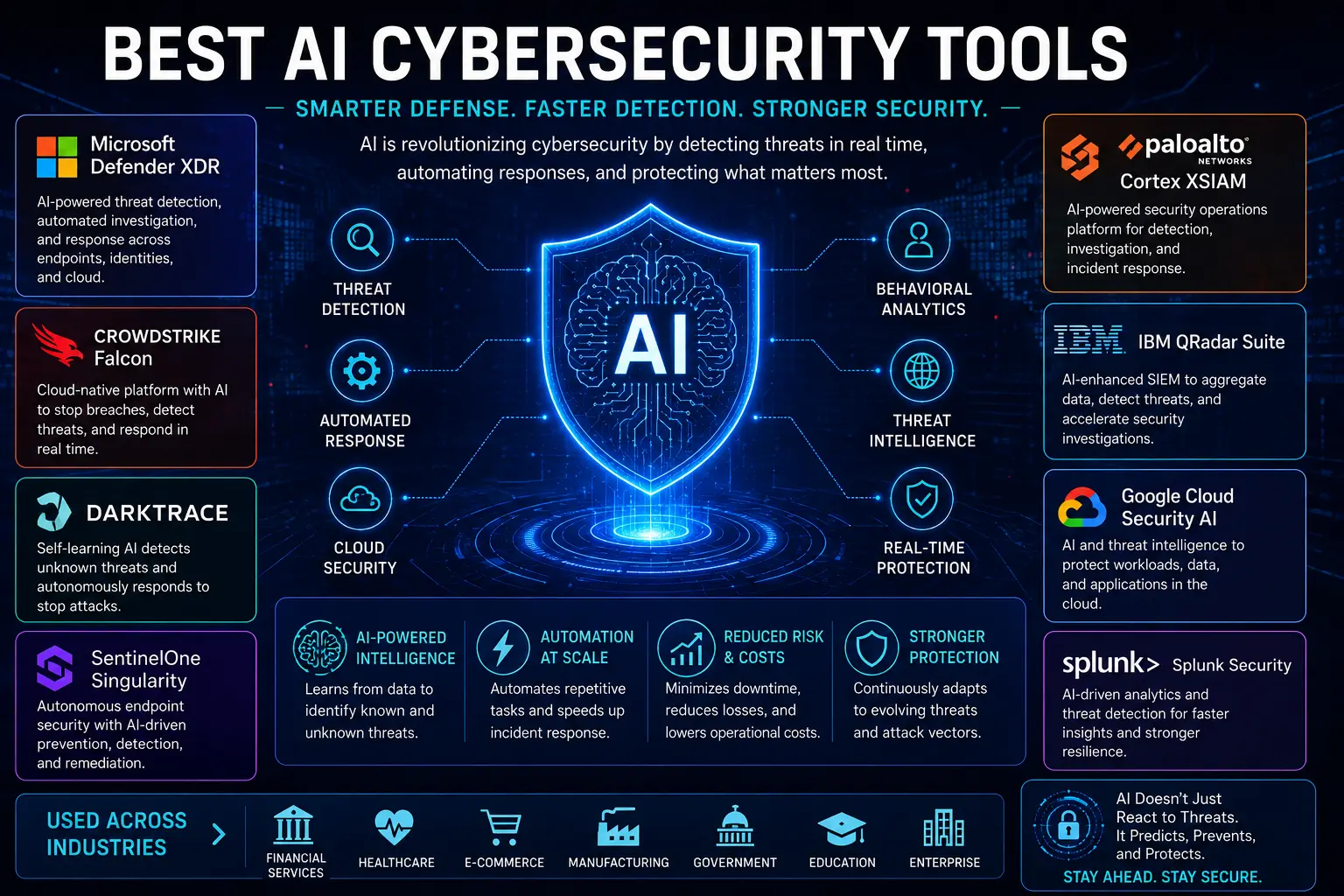
Discover the best AI cybersecurity tools in 2026. Compare features, benefits, use cases, and AI-powered solutions for modern cyber defense.
Introduction
Cybersecurity threats are becoming more sophisticated, frequent, and costly. Organizations of all sizes face an expanding attack surface driven by cloud adoption, remote work, connected devices, and increasingly advanced cybercriminal tactics. Traditional security tools alone are often unable to keep pace with modern threats, creating a growing demand for intelligent, automated defense systems.
This is where the best AI cybersecurity tools are making a significant impact. Artificial intelligence is transforming how security teams detect threats, investigate incidents, automate responses, and protect critical assets. By leveraging machine learning, behavioral analytics, threat intelligence, and predictive algorithms, AI-powered cybersecurity platforms can identify attacks faster and more accurately than traditional methods.
From endpoint protection and threat detection to security operations automation and cloud security monitoring, AI cybersecurity solutions are becoming essential components of modern cyber defense strategies.
This comprehensive guide explores the best AI cybersecurity tools available today, their capabilities, benefits, challenges, real-world applications, and future developments shaping the cybersecurity landscape.
What Are AI Cybersecurity Tools?
AI cybersecurity tools are security solutions that use artificial intelligence technologies to identify, analyze, prevent, and respond to cyber threats.
Unlike traditional rule-based systems, AI-powered platforms continuously learn from data and adapt to evolving attack patterns.
Core AI Technologies Used in Cybersecurity
Machine Learning
Machine learning enables security systems to identify unusual behavior and emerging threats based on historical and real-time data.
Behavioral Analytics
AI establishes baselines of normal activity and detects deviations that may indicate malicious behavior.
Deep Learning
Deep learning models identify complex attack patterns across massive datasets.
Natural Language Processing (NLP)
NLP helps analyze:
- Threat intelligence reports
- Security alerts
- Phishing emails
- Dark web discussions
Predictive Analytics
AI can forecast potential risks and identify vulnerabilities before attackers exploit them.
Why Organizations Are Adopting AI Cybersecurity Tools
Several factors are accelerating AI adoption in cybersecurity.
Increasing Cyber Threat Complexity
Modern attacks often involve:
- Ransomware
- Zero-day exploits
- Supply chain attacks
- Advanced persistent threats (APTs)
Alert Overload
Security teams often receive thousands of alerts daily.
AI helps prioritize and filter security events.
Security Skills Shortage
Organizations face ongoing shortages of cybersecurity professionals.
AI automates many routine tasks and improves analyst efficiency.
Need for Faster Response
Attackers can compromise systems within minutes.
AI enables near real-time detection and response.
Best AI Cybersecurity Tools in 2026
1. Microsoft Defender XDR
Microsoft Defender XDR is one of the most comprehensive AI-powered security platforms available.
Key Features
- Extended detection and response (XDR)
- Threat intelligence integration
- Automated investigation
- AI-powered threat hunting
Best For
- Enterprise environments
- Microsoft ecosystem users
- Hybrid cloud security
Advantages
Microsoft leverages extensive threat intelligence from its global infrastructure, providing exceptional visibility into emerging threats.
2. CrowdStrike Falcon
CrowdStrike Falcon is a cloud-native cybersecurity platform known for advanced endpoint protection.
AI Capabilities
- Behavioral analysis
- Threat intelligence
- Automated detection
- Incident response
Key Benefits
- Lightweight deployment
- Strong ransomware protection
- Real-time threat monitoring
Ideal Users
- Enterprises
- Managed security providers
- Remote workforce environments
3. Darktrace
Darktrace is widely recognized for its self-learning AI approach.
Core Features
- Autonomous threat detection
- Network monitoring
- Email security
- Cloud security
Unique Advantage
Darktrace creates a dynamic understanding of normal network behavior and identifies anomalies automatically.
Common Use Cases
- Insider threat detection
- Network visibility
- Advanced threat monitoring
4. Palo Alto Networks Cortex XSIAM
Cortex XSIAM combines AI, automation, and security operations.
AI Functions
- Threat correlation
- Automated investigations
- Incident response
- Security analytics
Benefits
- Reduced analyst workload
- Faster remediation
- Improved visibility
Best For
Large organizations with complex security environments.
5. SentinelOne Singularity
SentinelOne provides autonomous AI-driven endpoint security.
Features
- Behavioral AI
- Automated threat response
- Ransomware protection
- Endpoint detection and response (EDR)
Strengths
- Fast threat mitigation
- Automated rollback capabilities
- Minimal manual intervention
6. IBM QRadar Suite
IBM QRadar combines AI with security information and event management (SIEM).
Key Capabilities
- Log analysis
- Threat intelligence
- Security orchestration
- AI-assisted investigations
Enterprise Benefits
Organizations gain centralized visibility and improved incident response.
7. Google Cloud Security AI
Google’s cybersecurity platform integrates AI-powered threat detection across cloud environments.
Features
- Threat intelligence
- Cloud security monitoring
- Malware detection
- Security analytics
Best Use Cases
- Cloud-native businesses
- Multi-cloud environments
- Large enterprises
8. Splunk Security
Splunk incorporates machine learning and advanced analytics into security operations.
AI Features
- Behavioral analytics
- Threat detection
- Risk scoring
- Security monitoring
Advantages
- Extensive integrations
- Flexible deployment
- Strong analytics capabilities
Comparison Table of the Best AI Cybersecurity Tools
| Tool | Primary Focus | AI Capabilities | Best For |
|---|---|---|---|
| Microsoft Defender XDR | Enterprise Security | Threat Detection, Automation | Microsoft Environments |
| CrowdStrike Falcon | Endpoint Protection | Behavioral Analysis | Enterprises |
| Darktrace | Network Security | Self-Learning AI | Threat Detection |
| Cortex XSIAM | Security Operations | Incident Automation | Large Organizations |
| SentinelOne | Endpoint Security | Autonomous Response | Ransomware Defense |
| IBM QRadar | SIEM | AI Investigations | Enterprise SOCs |
| Google Cloud Security | Cloud Security | Threat Intelligence | Cloud Environments |
| Splunk Security | Security Analytics | Risk Analysis | Security Teams |
How AI Cybersecurity Tools Improve Security
Faster Threat Detection
AI systems analyze millions of events in real time.
Example
Instead of manually reviewing logs, AI identifies suspicious behavior immediately.
Reduced False Positives
Machine learning improves alert accuracy.
Benefits include:
- Less analyst fatigue
- Faster investigations
- Better prioritization
Automated Incident Response
AI can:
- Isolate compromised devices
- Block malicious traffic
- Disable suspicious accounts
Result
Organizations reduce response times dramatically.
Threat Intelligence Enhancement
AI continuously analyzes global threat data to identify emerging attack techniques.
Improved Security Visibility
Organizations gain a more complete view of users, devices, applications, and networks.
Real-World Applications
Financial Services
Banks use AI cybersecurity tools to:
- Detect fraud
- Monitor transactions
- Prevent account takeovers
Healthcare
Hospitals protect:
- Patient records
- Medical devices
- Clinical systems
E-Commerce
Retailers defend against:
- Payment fraud
- Credential stuffing
- Account compromise
Manufacturing
Industrial organizations use AI to secure operational technology (OT) environments.
Government Agencies
Governments leverage AI to protect critical infrastructure and national security systems.
Benefits of Using the Best AI Cybersecurity Tools
Proactive Threat Detection
AI identifies threats before significant damage occurs.
24/7 Monitoring
Continuous protection without interruption.
Improved Efficiency
Automation reduces repetitive security tasks.
Faster Incident Response
Threats can be contained within seconds.
Enhanced Scalability
AI handles growing data volumes efficiently.
Better Threat Intelligence
Organizations gain deeper visibility into emerging threats.
Lower Operational Costs
Reduced manual workload improves resource utilization.
Challenges and Limitations
Despite their advantages, AI cybersecurity tools are not perfect.
High Implementation Costs
Enterprise-grade AI solutions often require significant investment.
Data Quality Requirements
Poor-quality data can reduce AI effectiveness.
Adversarial AI Attacks
Attackers increasingly attempt to manipulate AI models.
Integration Complexity
Some platforms require substantial configuration and tuning.
False Positives
Although improved, occasional incorrect alerts still occur.
Skills Gap
Organizations need personnel who understand both AI and cybersecurity.
Industry Insights and Trends
Several major trends are influencing AI cybersecurity.
Extended Detection and Response (XDR)
XDR platforms are becoming the standard for unified security operations.
AI-Powered Security Operations Centers
Modern SOCs increasingly rely on AI-assisted investigations.
Cloud-Native Security
Cloud adoption continues driving demand for AI-powered protection.
Generative AI Security Tools
Generative AI is being used for:
- Threat analysis
- Incident summaries
- Security reporting
- Threat hunting support
Zero Trust Integration
AI enhances Zero Trust architectures through continuous risk assessment.
Future Trends in AI Cybersecurity
Autonomous Security Systems
Future platforms may independently detect and remediate threats.
Predictive Threat Modeling
AI will increasingly forecast attack scenarios before they occur.
Enhanced Behavioral Analytics
Future systems will gain deeper understanding of user and device behavior.
AI-Powered Threat Hunting
Security teams will identify hidden threats faster using intelligent analytics.
Quantum-Resistant Security
AI will help organizations prepare for post-quantum cybersecurity challenges.
Explainable AI
Future security platforms will provide more transparent reasoning behind alerts and recommendations.
FAQ
1. What are the best AI cybersecurity tools?
Leading AI cybersecurity tools include Microsoft Defender XDR, CrowdStrike Falcon, Darktrace, SentinelOne, IBM QRadar, Cortex XSIAM, Google Cloud Security AI, and Splunk Security.
2. How do AI cybersecurity tools work?
They use machine learning, behavioral analytics, threat intelligence, and automation to detect and respond to cyber threats.
3. Are AI cybersecurity tools better than traditional security solutions?
AI tools complement traditional security systems by improving detection accuracy, automation, and threat visibility.
4. Can AI cybersecurity tools stop ransomware?
Many AI-powered platforms can detect ransomware behavior early and automatically isolate affected systems to limit damage.
5. Are AI security tools suitable for small businesses?
Yes. Many vendors offer scalable solutions designed for organizations of all sizes.
6. Can AI cybersecurity replace security analysts?
No. AI enhances analyst capabilities but does not replace human expertise, judgment, and strategic decision-making.
7. What should organizations consider before selecting an AI cybersecurity platform?
Important factors include:
- Deployment model
- Integration capabilities
- Threat detection effectiveness
- Automation features
- Cost
- Vendor reputation
Conclusion
The best AI cybersecurity tools are fundamentally changing how organizations defend against modern cyber threats. By combining machine learning, behavioral analytics, automation, and threat intelligence, these platforms deliver faster detection, improved visibility, and more efficient incident response than traditional security solutions alone.
As cyber threats continue to evolve, AI-powered security technologies will become increasingly important for businesses, governments, and individuals seeking proactive defense strategies. While challenges such as implementation complexity, cost, and adversarial AI remain, the benefits of intelligent cybersecurity solutions far outweigh the limitations.
Organizations that invest in the right AI cybersecurity tools today will be better prepared to address tomorrow’s threats while improving operational efficiency and overall cyber resilience.
Key Takeaways
- The best AI cybersecurity tools use machine learning and automation to strengthen cyber defense.
- Microsoft Defender XDR, CrowdStrike Falcon, Darktrace, and SentinelOne are among the leading solutions.
- AI improves threat detection, incident response, and security visibility.
- Modern AI platforms reduce alert fatigue and improve analyst productivity.
- Cloud security, endpoint protection, and XDR are major AI cybersecurity use cases.
- AI helps organizations identify unknown and emerging threats.
- Cybersecurity teams benefit from automated investigations and threat hunting.
- Adversarial AI and implementation complexity remain challenges.
- Generative AI is becoming an important component of security operations.
- AI-powered cybersecurity will continue shaping the future of digital defense.
