
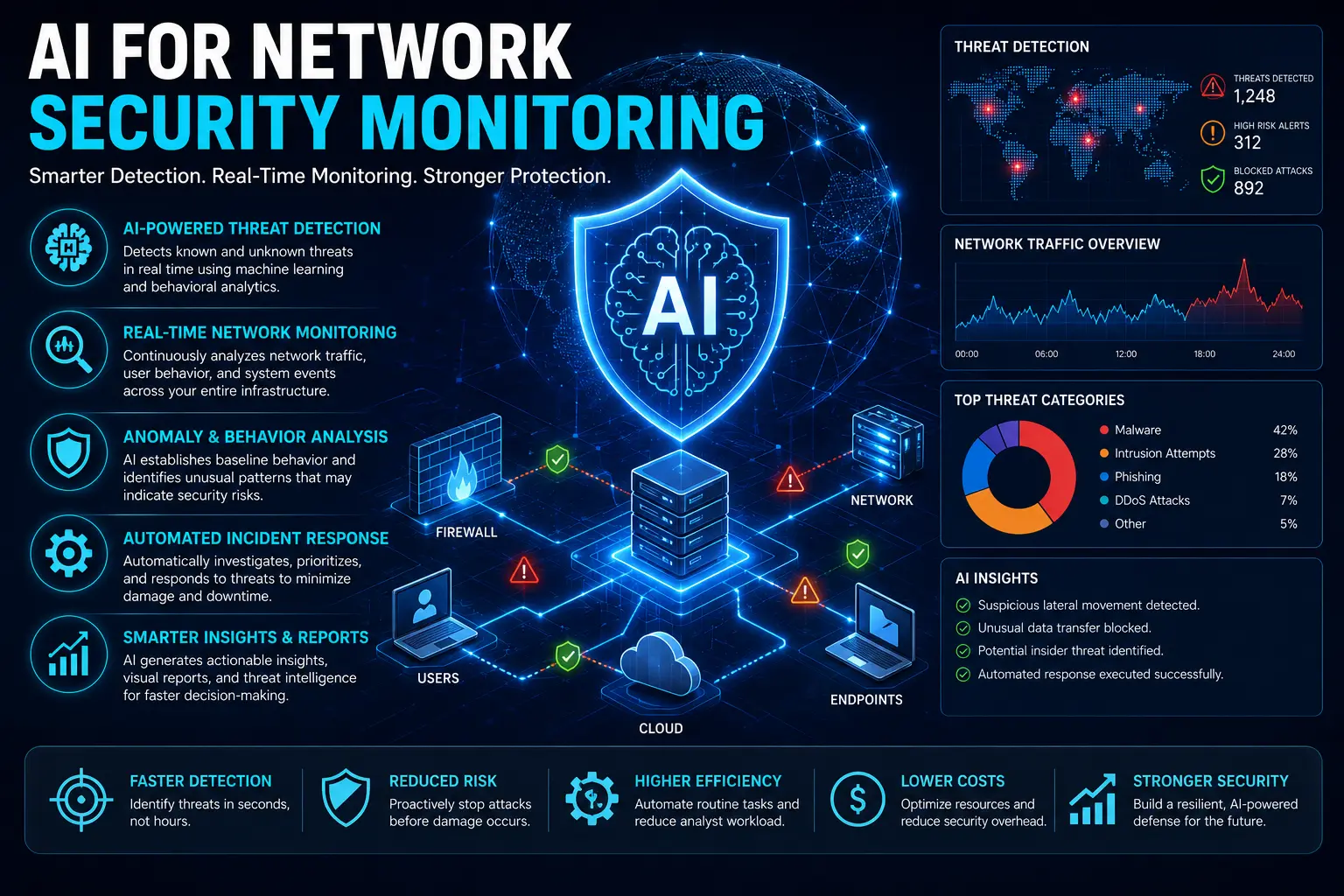
Discover how AI for network security monitoring improves threat detection, automates incident response, and strengthens cyber defense in 2026.
Introduction
Modern networks generate enormous amounts of data every second. From cloud applications and remote workers to IoT devices and enterprise servers, organizations must monitor thousands—or even millions—of network events daily. Traditional security monitoring tools often struggle to keep pace with this growing complexity, leaving security teams overwhelmed by alerts and vulnerable to sophisticated cyber threats.
This is where AI for network security monitoring is transforming cybersecurity. Artificial intelligence enables organizations to analyze vast amounts of network traffic in real time, identify suspicious behavior, detect threats faster, and automate security responses. Instead of relying solely on predefined rules, AI-powered systems continuously learn from network activity and adapt to emerging attack techniques.
As cyberattacks become more advanced and attackers increasingly use automation, AI-driven network monitoring is becoming an essential component of modern cyber defense. This guide explores how AI is revolutionizing network security monitoring, its benefits, use cases, challenges, industry trends, and future developments shaping cybersecurity in 2026 and beyond.
What Is AI for Network Security Monitoring?
AI for network security monitoring refers to the use of artificial intelligence technologies to observe, analyze, and protect network environments against cyber threats.
AI-powered monitoring systems continuously inspect:
- Network traffic
- User behavior
- Device activity
- Data transfers
- Authentication events
- Application communications
Unlike traditional monitoring tools that depend heavily on signatures and static rules, AI systems can identify unusual patterns, unknown threats, and emerging attack techniques.
Core Technologies Behind AI Network Monitoring
Machine Learning
Machine learning enables systems to learn normal network behavior and identify deviations that may indicate security threats.
Deep Learning
Deep learning algorithms process massive datasets and uncover complex attack patterns that humans may overlook.
Behavioral Analytics
Behavioral analytics helps establish baseline activity for users, devices, and applications.
Natural Language Processing (NLP)
NLP assists with:
- Threat intelligence analysis
- Security report processing
- Incident summaries
- Security operations automation
Predictive Analytics
AI can anticipate future risks by analyzing historical and real-time network data.
Why Traditional Network Monitoring Is No Longer Enough
Network environments have changed dramatically.
Growing Attack Surface
Organizations now manage:
- Cloud infrastructure
- Hybrid environments
- Remote employees
- Mobile devices
- IoT ecosystems
This creates more potential entry points for attackers.
Alert Fatigue
Security teams often receive thousands of alerts daily.
Many alerts are:
- False positives
- Low-priority events
- Duplicate notifications
AI helps reduce noise and prioritize genuine threats.
Sophisticated Cyber Threats
Modern attacks include:
- Ransomware
- Fileless malware
- Insider threats
- Advanced Persistent Threats (APTs)
- Zero-day exploits
Traditional monitoring solutions frequently struggle to detect these threats early.
How AI for Network Security Monitoring Works
AI-powered monitoring follows a continuous process.
Data Collection
The system gathers information from:
- Firewalls
- Routers
- Switches
- Endpoints
- Cloud services
- Security logs
Behavioral Baseline Creation
AI establishes normal patterns for:
- Users
- Devices
- Applications
- Network traffic
Real-Time Analysis
Machine learning models continuously evaluate activity against established baselines.
Threat Detection
The system identifies:
- Anomalies
- Suspicious communications
- Potential intrusions
- Malicious behaviors
Automated Response
Advanced platforms can:
- Block traffic
- Isolate devices
- Generate alerts
- Launch investigations
Key Applications of AI in Network Security Monitoring
Anomaly Detection
Anomaly detection is one of the most important uses of AI.
Example
A user typically logs in from New York during business hours.
Suddenly, the same account logs in from multiple countries within minutes.
AI recognizes the unusual activity and flags the account.
Benefits
- Faster threat detection
- Reduced breach risk
- Early warning capabilities
Intrusion Detection Systems (IDS)
AI-powered IDS solutions analyze network activity for signs of malicious behavior.
Capabilities
- Detect unauthorized access
- Identify malware communications
- Monitor lateral movement
- Recognize attack patterns
Real-World Example
An attacker attempts to move between systems after compromising a workstation.
AI identifies the unusual network behavior and triggers alerts before major damage occurs.
Threat Hunting
AI significantly improves threat hunting capabilities.
How It Helps
AI can:
- Correlate events across systems
- Identify hidden threats
- Discover attack chains
- Prioritize investigations
This allows analysts to focus on high-risk incidents.
Malware Detection
Traditional malware detection relies heavily on signatures.
AI detects malware based on behavior.
Examples
- Fileless malware
- Polymorphic malware
- Unknown malware variants
This improves protection against emerging threats.
Insider Threat Detection
Not all threats originate externally.
AI helps identify insider risks by analyzing:
- User behavior
- Data access patterns
- Privilege usage
- Unusual activities
Example
An employee suddenly downloads thousands of sensitive documents outside normal working hours.
AI flags the activity for investigation.
DDoS Attack Detection
Distributed Denial-of-Service (DDoS) attacks can overwhelm networks.
AI helps by:
- Monitoring traffic volumes
- Identifying abnormal spikes
- Detecting attack patterns
- Triggering automated mitigation
Comparison Table: Traditional vs AI-Powered Network Security Monitoring
| Feature | Traditional Monitoring | AI-Powered Monitoring |
|---|---|---|
| Threat Detection | Signature-Based | Behavioral & Predictive |
| Unknown Threat Detection | Limited | Advanced |
| Alert Management | Manual | Intelligent Prioritization |
| Response Time | Slower | Real-Time |
| Scalability | Moderate | High |
| Learning Capability | Static Rules | Continuous Learning |
| False Positive Reduction | Limited | Improved |
Leading AI Network Security Monitoring Platforms
Several cybersecurity vendors have integrated AI into network monitoring.
Darktrace
Known for self-learning AI and autonomous threat detection.
Features
- Network visibility
- Threat detection
- Autonomous response
Cisco Secure Network Analytics
Provides advanced network behavior analysis.
Capabilities
- Traffic monitoring
- Threat intelligence
- Risk detection
Microsoft Defender XDR
Offers AI-driven monitoring across networks, endpoints, identities, and cloud environments.
Benefits
- Unified visibility
- Automated investigations
- Threat correlation
Palo Alto Cortex XDR
Combines network telemetry with AI analytics.
Features
- Threat hunting
- Incident response
- Behavioral analytics
ExtraHop Reveal(x)
Specializes in network detection and response (NDR).
Strengths
- Real-time monitoring
- AI threat detection
- Cloud visibility
Real-World Applications
Financial Services
Banks use AI network monitoring to:
- Detect fraud
- Prevent account compromise
- Secure transactions
Healthcare
Hospitals monitor networks to protect:
- Patient records
- Medical devices
- Healthcare systems
Manufacturing
Industrial organizations secure:
- Operational technology (OT)
- Industrial control systems
- Smart factories
Government Agencies
Governments deploy AI to defend critical infrastructure.
E-Commerce
Online retailers use AI monitoring to prevent:
- Payment fraud
- Credential theft
- Data breaches
Benefits of AI for Network Security Monitoring
Faster Threat Detection
AI analyzes traffic in real time and identifies threats quickly.
Reduced False Positives
Machine learning improves alert accuracy.
Continuous Monitoring
AI operates 24/7 without interruption.
Improved Incident Response
Automated workflows accelerate containment efforts.
Enhanced Visibility
Organizations gain deeper insights into network activity.
Better Scalability
AI can process massive amounts of data efficiently.
Proactive Security
Predictive analytics helps prevent attacks before they succeed.
AI Cybersecurity Industry Trends
Several trends are shaping network security monitoring.
Network Detection and Response (NDR)
NDR platforms increasingly rely on AI for advanced visibility and threat detection.
Extended Detection and Response (XDR)
XDR integrates:
- Network monitoring
- Endpoint protection
- Identity security
- Cloud security
into a unified platform.
Cloud-Native Security
AI-powered monitoring tools are increasingly designed for cloud environments.
Generative AI Integration
Security teams now use generative AI for:
- Threat analysis
- Investigation summaries
- Incident reporting
- Security recommendations
Challenges and Limitations
Despite its advantages, AI monitoring faces challenges.
False Positives
Although improved, AI systems can still generate incorrect alerts.
Data Quality Issues
Poor-quality data reduces AI effectiveness.
Implementation Complexity
Deploying AI monitoring requires:
- Skilled personnel
- Proper configuration
- Continuous optimization
Privacy Concerns
Monitoring user activity raises compliance and privacy considerations.
Adversarial AI Attacks
Attackers increasingly attempt to manipulate AI systems.
Examples include:
- Data poisoning
- Model evasion
- Adversarial inputs
Future Trends in AI Network Security Monitoring
Autonomous Security Operations
Future platforms may independently:
- Detect threats
- Investigate incidents
- Execute remediation
with minimal human involvement.
Predictive Threat Intelligence
AI will increasingly forecast attack campaigns before they occur.
AI-Powered Digital Twins
Organizations may simulate network environments to identify weaknesses before attackers exploit them.
Enhanced Behavioral Analytics
Future systems will develop more accurate user and device behavior models.
Quantum-Aware Security Monitoring
As quantum computing evolves, AI monitoring tools will help organizations prepare for new cryptographic risks.
Explainable AI
Security teams increasingly demand transparency regarding AI-generated decisions and alerts.
FAQ
1. What is AI for network security monitoring?
AI for network security monitoring uses artificial intelligence to analyze network traffic, detect threats, identify anomalies, and automate cybersecurity operations.
2. How does AI improve network security?
AI improves network security through real-time threat detection, behavioral analytics, automated responses, and predictive threat intelligence.
3. Can AI detect unknown cyber threats?
Yes. AI can identify suspicious behaviors and anomalies that may indicate previously unseen threats, including zero-day attacks and advanced malware.
4. What is the difference between AI monitoring and traditional monitoring?
Traditional monitoring relies on predefined rules and signatures, while AI monitoring continuously learns and adapts to evolving threats.
5. Is AI network monitoring suitable for small businesses?
Yes. Many vendors offer scalable AI-powered solutions suitable for businesses of all sizes.
6. Can AI replace network security analysts?
No. AI enhances security teams by automating repetitive tasks and improving visibility, but human expertise remains essential.
7. What are the biggest challenges of AI security monitoring?
Key challenges include implementation complexity, privacy concerns, false positives, data quality issues, and adversarial attacks against AI models.
Conclusion
AI for network security monitoring is transforming how organizations defend against modern cyber threats. By leveraging machine learning, behavioral analytics, predictive intelligence, and automation, AI enables faster threat detection, more accurate monitoring, and stronger cyber resilience.
As network environments continue to grow more complex, AI-powered monitoring solutions are becoming indispensable for identifying threats that traditional tools may miss. From anomaly detection and threat hunting to intrusion detection and automated response, AI is helping organizations move from reactive security to proactive cyber defense.
Businesses that invest in intelligent network monitoring platforms today will be better positioned to protect critical assets, reduce risk, and stay ahead of evolving cyber threats in 2026 and beyond.
Key Takeaways
- AI for network security monitoring enhances threat detection through machine learning and behavioral analytics.
- AI can identify unknown threats, insider risks, and suspicious network activity in real time.
- Network Detection and Response (NDR) platforms increasingly rely on AI technologies.
- AI reduces false positives and improves alert prioritization.
- Organizations benefit from continuous 24/7 network monitoring.
- AI strengthens threat hunting and incident response capabilities.
- Cloud security and XDR platforms are driving AI adoption.
- Adversarial AI attacks and privacy concerns remain challenges.
- Future systems will become more autonomous and predictive.
- AI-powered monitoring is becoming a core component of modern cybersecurity strategies.
