
Explore the future of artificial intelligence industry, emerging trends, innovations, challenges, opportunities, and how AI will transform businesses and society.
Introduction
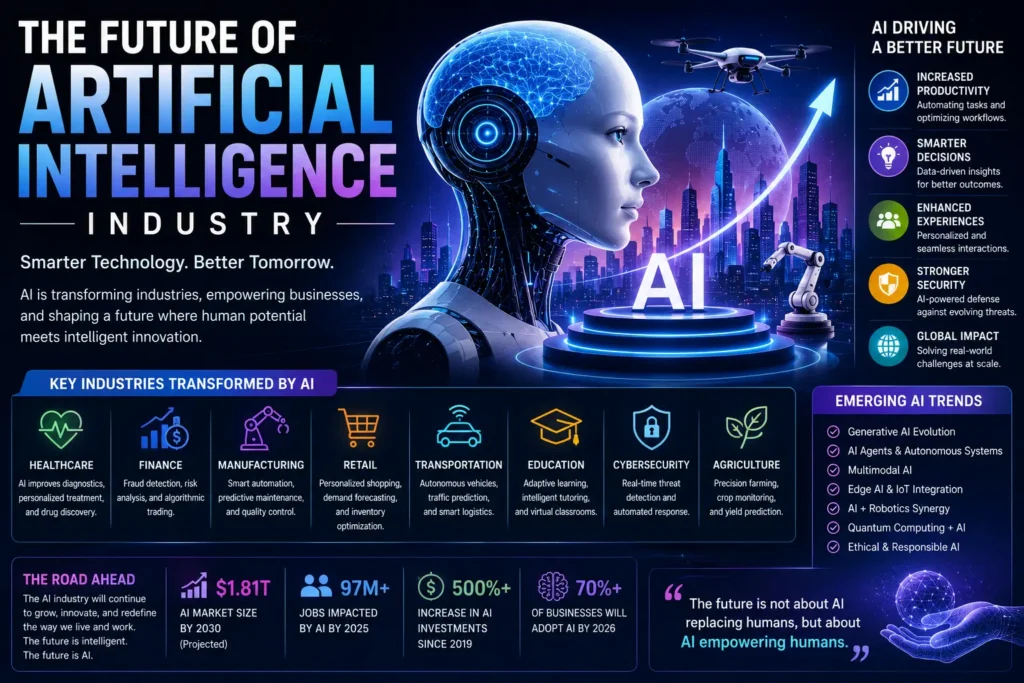
Artificial intelligence has evolved from a niche research field into one of the most influential technologies shaping the modern world. From generative AI tools and intelligent automation to autonomous systems and advanced cybersecurity solutions, AI is transforming industries at a pace rarely seen in technological history.
Understanding the future of artificial intelligence industry is essential for businesses, investors, developers, policymakers, and technology enthusiasts. Organizations worldwide are investing billions of dollars in AI research, infrastructure, and applications to improve productivity, gain competitive advantages, and unlock new opportunities.
As we move deeper into the AI era, the industry is expected to experience significant growth driven by advances in machine learning, generative AI, robotics, cloud computing, edge AI, and human-machine collaboration. At the same time, challenges surrounding regulation, ethics, cybersecurity, and workforce transformation continue to shape the industry’s direction.
This comprehensive guide explores the future of the artificial intelligence industry, key growth drivers, emerging technologies, industry applications, market opportunities, challenges, and long-term trends expected to define the next decade.
Understanding the Current AI Industry Landscape
Before examining the future, it’s important to understand where the industry stands today.
Rapid Growth Across Industries
Artificial intelligence is now widely adopted across:
- Healthcare
- Finance
- Manufacturing
- Retail
- Cybersecurity
- Education
- Transportation
- Media
Organizations increasingly view AI as a core business capability rather than an experimental technology.
The Rise of Generative AI
Generative AI has become one of the biggest catalysts for industry growth.
Popular Applications
- Content creation
- Software development
- Customer service
- Marketing automation
- Business intelligence
Generative AI has significantly accelerated enterprise AI adoption worldwide.
Key Drivers Shaping the Future of Artificial Intelligence Industry
Several powerful forces are driving AI’s continued expansion.
Increasing Data Availability
Modern businesses generate enormous volumes of data.
Sources Include
- Cloud platforms
- IoT devices
- Mobile applications
- Enterprise systems
- Social media
AI systems depend on high-quality data to learn and improve.
Advances in Computing Power
Powerful hardware continues enabling larger and more capable AI models.
Technologies Driving Progress
- AI accelerators
- GPUs
- High-performance computing
- Specialized AI chips
Companies such as NVIDIA, AMD, and Intel continue investing heavily in AI infrastructure.
Growing Enterprise Demand
Businesses increasingly seek AI solutions that can:
- Reduce costs
- Improve efficiency
- Enhance customer experiences
- Support decision-making
This demand continues driving innovation and investment.
Cloud and Edge Computing Expansion
Cloud computing enables scalable AI deployment while edge computing allows faster local processing.
Together, these technologies support the next generation of intelligent systems.
How the AI Industry Will Transform Major Sectors
Healthcare
Healthcare is expected to become one of the largest AI markets.
Future Applications
- Early disease detection
- Personalized medicine
- Drug discovery
- Robotic surgery
- Remote patient monitoring
Industry Impact
AI could improve diagnostic accuracy while reducing healthcare costs and administrative burdens.
Finance
Financial institutions continue expanding AI adoption.
Future Use Cases
- Fraud prevention
- Risk assessment
- Automated trading
- Customer support
- Credit analysis
AI will increasingly support real-time financial decision-making.
Manufacturing
Smart factories are becoming more intelligent.
AI Applications
- Predictive maintenance
- Quality assurance
- Robotics
- Supply chain optimization
Benefits
Manufacturers can reduce downtime and improve operational efficiency.
Cybersecurity
AI will play an increasingly important role in digital security.
Future Security Capabilities
- Autonomous threat detection
- Predictive risk analysis
- Automated incident response
- Behavioral monitoring
AI cybersecurity solutions will become critical as cyber threats grow more sophisticated.
Education
Education is likely to become more personalized.
AI-Powered Learning
Future systems may offer:
- Adaptive learning paths
- Intelligent tutoring
- Real-time feedback
- Personalized educational content
Emerging Technologies Driving the Future of AI
AI Agents
AI agents represent one of the most significant developments in the industry.
What Are AI Agents?
AI agents can:
- Perform tasks independently
- Make decisions
- Manage workflows
- Interact with systems
Potential Applications
- Customer service
- Research assistance
- Project management
- Business automation
Many experts believe AI agents will become a major economic force.
Multimodal AI
Future AI systems will increasingly understand multiple forms of information.
Data Types
- Text
- Images
- Audio
- Video
- Sensor data
Benefits
Multimodal AI enables more natural and powerful interactions.
Robotics and Autonomous Systems
AI-powered robotics continues advancing rapidly.
Future Developments
- Warehouse automation
- Industrial robotics
- Service robots
- Autonomous vehicles
Robots will increasingly perform complex physical tasks alongside humans.
Edge AI
Edge AI processes information directly on devices.
Advantages
- Reduced latency
- Better privacy
- Lower bandwidth requirements
This trend is particularly important for:
- Smart devices
- Healthcare equipment
- Industrial systems
- Autonomous machines
AI Industry Growth Opportunities
Enterprise Software
AI-powered enterprise software is expected to remain a major growth area.
Popular Solutions
- AI assistants
- Business analytics
- Workflow automation
- Knowledge management
AI Infrastructure
Infrastructure providers benefit from growing demand for AI computing resources.
Key Areas
- Data centers
- AI chips
- Cloud services
- Networking infrastructure
AI Cybersecurity
Cybersecurity represents one of the fastest-growing AI sectors.
Demand Drivers
- Rising cyber threats
- Compliance requirements
- Digital transformation
AI-Powered Consumer Products
Consumers increasingly interact with AI through:
- Smartphones
- Smart home devices
- Wearables
- Personal assistants
This market is expected to expand significantly.
Comparison Table: Current AI vs Future AI Industry
| Category | Current State | Future Outlook |
|---|---|---|
| AI Assistants | Task Support | Autonomous Agents |
| Cybersecurity | Threat Detection | Predictive Defense |
| Healthcare | Diagnostics Support | Personalized Treatment |
| Manufacturing | Automation | Fully Intelligent Factories |
| Education | Online Learning | Adaptive AI Tutors |
| Robotics | Limited Tasks | Complex Autonomous Operations |
| Smart Devices | Voice Commands | Context-Aware Intelligence |
| Enterprise AI | Process Automation | Strategic Decision Support |
Economic Impact of the Future AI Industry
Increased Productivity
AI will automate repetitive tasks across industries.
Expected Outcomes
- Higher efficiency
- Faster workflows
- Reduced costs
Job Transformation
AI will reshape many job roles.
Emerging Careers
- AI engineers
- AI ethics specialists
- Prompt engineers
- AI security analysts
- Machine learning researchers
While some jobs may change, new opportunities are expected to emerge.
New Business Models
AI enables entirely new products and services.
Examples include:
- AI-as-a-Service
- Autonomous platforms
- Personalized digital experiences
Benefits of the Future Artificial Intelligence Industry
Improved Efficiency
Organizations can automate routine tasks and optimize operations.
Better Decision-Making
AI provides actionable insights from large datasets.
Enhanced Innovation
Businesses can accelerate research and development.
Improved Customer Experiences
AI enables personalized interactions and services.
Stronger Cybersecurity
AI enhances threat detection and incident response.
Economic Growth
AI contributes to investment, entrepreneurship, and productivity gains.
Scientific Advancement
Researchers can solve complex problems faster using AI-powered tools.
Challenges and Limitations
Despite its promise, the future of AI presents challenges.
Ethical Concerns
Important issues include:
- Bias
- Fairness
- Transparency
- Accountability
Data Privacy
AI systems often require large amounts of user data.
Organizations must balance innovation with privacy protection.
Cybersecurity Risks
AI systems themselves can become targets.
Threats Include
- Model manipulation
- Data poisoning
- Adversarial attacks
Workforce Disruption
Some roles may be significantly altered through automation.
Organizations must prioritize workforce development and reskilling.
Regulatory Complexity
Governments worldwide continue developing AI regulations.
Compliance requirements are expected to increase.
Industry Insights and Expert Perspectives
AI Is Becoming Essential Infrastructure
Industry leaders increasingly compare AI to electricity or the internet in terms of transformative potential.
Enterprise Adoption Will Accelerate
Organizations are moving from experimentation to large-scale deployment.
Human-AI Collaboration Will Dominate
The future is unlikely to involve AI replacing humans entirely.
Instead, successful organizations will focus on collaboration between people and intelligent systems.
Responsible AI Will Become a Competitive Advantage
Companies demonstrating transparency and ethical AI practices may gain stronger trust and market acceptance.
Future Trends
Autonomous AI Ecosystems
Future systems may coordinate multiple AI agents to accomplish complex objectives.
AI-Powered Scientific Discovery
AI will continue accelerating breakthroughs in:
- Medicine
- Biotechnology
- Materials science
- Climate research
Personalized AI Assistants
Future assistants will become highly context-aware and proactive.
Quantum-AI Integration
The combination of quantum computing and AI may unlock entirely new capabilities.
Industry-Specific AI Platforms
Specialized AI solutions will emerge for nearly every sector.
Global AI Competition
Governments and corporations will continue investing heavily to secure AI leadership.
FAQ
1. What is the future of artificial intelligence industry?
The future of the artificial intelligence industry includes widespread enterprise adoption, autonomous AI systems, AI agents, advanced robotics, personalized AI services, and significant economic growth.
2. Which industries will benefit most from AI?
Healthcare, finance, manufacturing, cybersecurity, education, transportation, and retail are expected to see major benefits.
3. Will AI replace human workers?
AI will automate certain tasks, but most experts expect it to transform jobs rather than eliminate all human roles. New AI-related careers are also emerging.
4. What are AI agents?
AI agents are intelligent systems capable of independently performing tasks, making decisions, and managing workflows with minimal human intervention.
5. What challenges could slow AI growth?
Challenges include regulation, privacy concerns, cybersecurity risks, infrastructure costs, ethical issues, and talent shortages.
6. How important is AI cybersecurity?
AI cybersecurity will become increasingly important as organizations use AI to defend against sophisticated cyber threats.
7. What role will governments play in AI development?
Governments will influence AI through regulation, research funding, infrastructure investment, and national AI strategies.
Conclusion
The future of artificial intelligence industry is poised to be one of the most transformative developments in modern history. Advances in generative AI, autonomous agents, robotics, cybersecurity, healthcare, and enterprise automation are creating unprecedented opportunities for innovation and growth.
While challenges related to ethics, privacy, regulation, and workforce transformation remain important considerations, the long-term trajectory of AI continues to point toward widespread adoption and economic impact. Organizations that invest in AI capabilities today will be better positioned to compete, innovate, and thrive in an increasingly intelligent digital economy.
As AI technologies mature, they will become deeply integrated into every aspect of business and society, shaping how people work, learn, communicate, and solve complex global challenges.
Key Takeaways
- The future of artificial intelligence industry is driven by rapid innovation and growing adoption.
- AI agents are expected to become a major industry trend.
- Healthcare, cybersecurity, finance, and manufacturing will experience significant transformation.
- Generative AI continues accelerating enterprise adoption.
- AI infrastructure remains critical for future growth.
- Human-AI collaboration will become increasingly important.
- Ethical AI and governance will shape long-term success.
- Edge AI and robotics will expand intelligent automation.
- AI will contribute significantly to economic growth and productivity.
- Businesses that embrace AI strategically will gain competitive advantages in the years ahead.
